

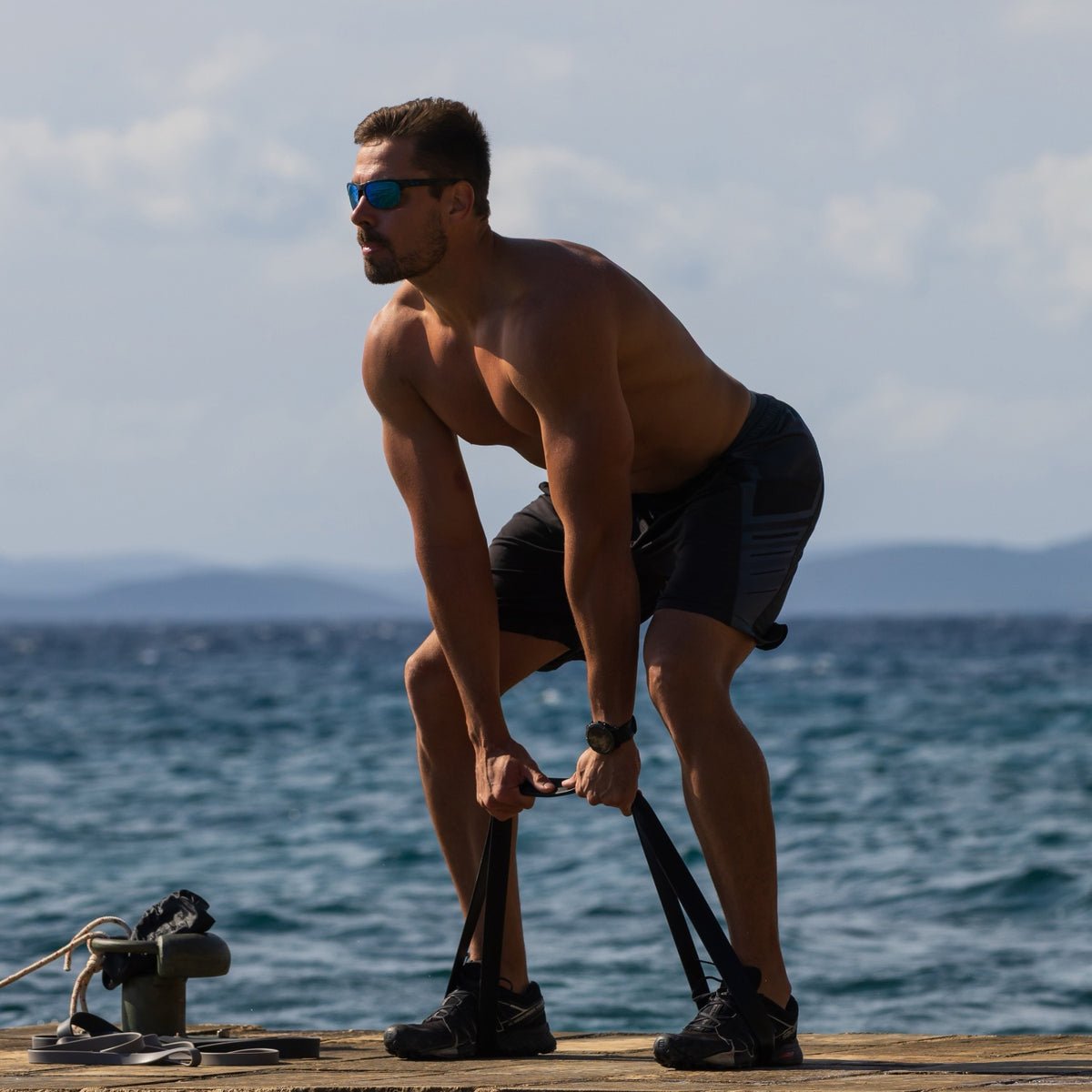
The hip hinge is the base pattern behind deadlifts, kettlebell swings and picking something up from the floor. Many people bend the knees and drop into a squat when the hips should travel back. A resistance band gives you feedback and load together, so you can learn the hinge movement at home. This banded hip hinge practice is a self-test plus five drills.
What a banded hip hinge is
In a hip hinge exercise the hips travel back. The knees stay soft and stacked over the ankles, and the shins stay close to vertical. The spine stays long and neutral. Your weight sits on the mid-foot, not on the toes. You stand by driving the hips forward.
The load goes to the glutes, the hamstrings and the muscles that hold the spine long. Together they are the posterior chain, and the wider set of moves is in our guide to posterior chain exercises.
A squat sends the knees forward and drops the hips, so the thighs do most of the work. If that is what you do when you mean to hinge, you are quad dominant. The front of the thighs takes a job the backside should share. If you have back pain or an injury, check with a physio or doctor before you practice.
Hinge or squat: a quick self-test
Wall test. Stand with your back to a wall, about one foot length away, knees soft. Push the hips back until the glutes touch the wall, and do not let the knees travel forward. If the knees move forward, or you lose balance before you touch, you are squatting the movement.
Stick test. Hold a broomstick or a dowel along the spine so it touches the back of the head, the upper back and the tailbone. Hinge forward and keep all three contacts. If one point leaves the stick, shorten the range.
Signs you are quad dominant:
- The knees travel forward before the hips travel back.
- The heels lift as you lower.
- The lower back rounds.
- You feel the work in the front of the thighs, rather than in the back of the thighs and the glutes.
Which band you need, and how to anchor it
Use Light (10 kg) or Medium (20 kg) for drills 1 and 2. When your technique is solid, Medium (20 kg) or Heavy (30 kg) fits pull throughs and the banded Romanian deadlift. The Premium Powerbands are large closed loops. Every band is 100 cm long and 4 mm thick, cast from latex-free silicone with rounded edges. It feels velvety and does not stick. The levels are Light (10 kg), Medium (20 kg), Heavy (30 kg) and Very Heavy (40 kg). A set of four reaches up to 100 kg combined. Anchor the band to a sturdy, fixed point at hip height or ankle height, such as a rack, a post or a heavy object that cannot move. Check the band for damage before each session. Never anchor it to anything that can slide, roll or tip.
1. Banded hip hinge drill

Setup: Anchor the band at hip height behind you. Step into the loop so it sits in the hip crease, and walk forward until the band is under light tension. Hands rest on your hips, knees soft.
Movement: Let the band pull the hips back into the hinge. Keep the shins close to vertical and the spine long. Drive the hips forward to stand tall and squeeze the glutes.
Cues: The band shows you the direction. The knees stay soft and quiet. If they travel forward, you are squatting the drill.
2. Wall hip hinge

Setup: Stand about one foot length from a wall, back toward it, knees soft. Optional: hold a Light band stretched between both hands at arm's length, so the upper back stays engaged.
Movement: Push the hips back until the glutes touch the wall, then stand by squeezing the glutes. When that is easy, take one step further from the wall.
Cues: Touch with the glutes, not with the lower back. Do not row the optional band.
3. Banded pull through

Setup: Anchor the band low, at ankle height, behind you. Face away, take the band between your legs with both hands, and walk forward until there is tension.
Movement: Hinge so the hands travel back between the legs, then drive the hips forward to stand tall and squeeze the glutes. The arms only hold. They do not pull.
Cues: If the lower back rounds, shorten the hinge. The posterior chain guide lists pull throughs too. Here the focus is technique.
4. Banded Romanian deadlift

Setup: Stand on the band with both feet and hold it in both hands. Start tall, with a soft knee bend that stays as you lower.
Movement: Hinge with a long spine until you feel a stretch in the back of the thighs, then stand tall.
Cues: Keep this one short. Full setup, variations and programming are in the guide to the resistance band Romanian deadlift.
5. B-stance banded hinge

Setup: Stand on the band with the front foot. Set the back foot a half step behind, toes only, for balance. Most of your weight stays on the front leg.
Movement: Hinge on the front leg and stand back up. It bridges two-leg work and single-leg work. Count the reps per side.
Cues: If the front knee shoots forward, shorten the range. The back foot does not take the load.
Common mistakes
- Squatting instead of hinging, with the knees forward first.
- Rounding the lower back.
- Leaning back or overextending at the top, instead of standing tall with the glutes tight.
- A band that is too heavy, so it pulls you out of position or snaps back.
- Rushing the reps, with no control on the way down or up.
A 10-minute hip hinge practice
Do this 2 to 3 times a week, as part of your dynamic warm-up before leg or deadlift days, or as a short session on its own. Drill 1: 2 x 10. Drill 2: 2 x 8. Pull through: 3 x 12 to 15. Banded Romanian deadlift: 3 x 10 to 12. B-stance: 2 x 8 per side. Rest 30 to 60 s. To progress, slow the lowering phase, then use the next stronger band once every rep stays clean.
Once the hinge feels natural, take it into the guide to posterior chain exercises. For a faster hip drive, the kettlebell swing is the dynamic next step, for example with our fillable Kettlebell.
One band is enough to start. Find your resistance in the Premium Powerbands set, or see all Powerbands.

Leave a comment
All comments are moderated before being published.
This site is protected by hCaptcha and the hCaptcha Privacy Policy and Terms of Service apply.