

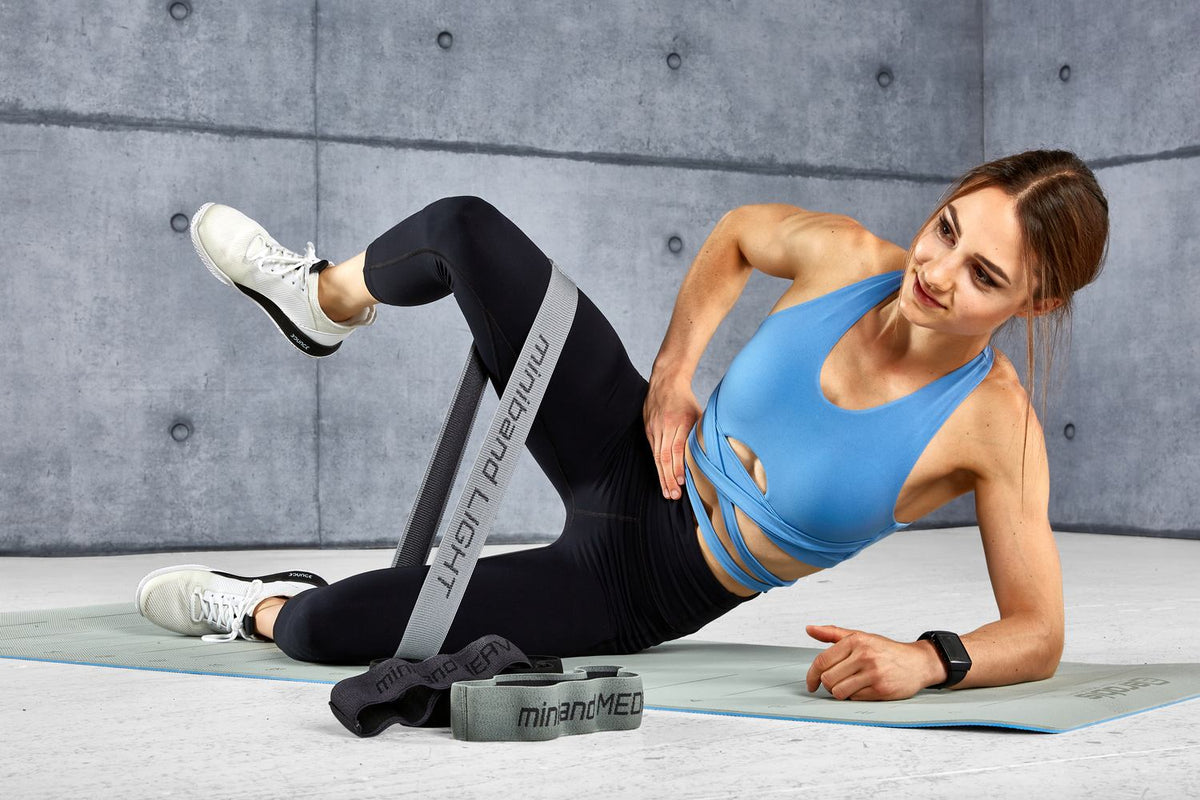
The clamshell is a small move with a clear job: it trains the side of your hip. You lie on your side with your knees bent and a miniband just above the knees. Your feet stay together while you open the top knee against the band, then you close it under control. Done well, it builds the hip strength that keeps your knees tracking over your toes in squats, lunges and running. All you need is two square meters of floor and a band that fits in your pocket.
Why a miniband for the clamshell?
Minibands are small closed textile loops, 33 cm long. They sit snugly around both thighs and stay in place while the knee opens, so the resistance works exactly where the side-hip muscles work. A large 100 cm powerband is the wrong tool here: it is too long to build real tension over such a short range. The product for this move is our Miniband Set.
What it trains
The main target is the gluteus medius, the muscle on the outside of your hip. It turns the thigh outward and keeps your pelvis level when you stand on one leg. The deep hip rotators help. Your midsection keeps the pelvis still, so the movement comes from the hip and not from rolling the trunk back.
That is why the clamshell shows up in so many warm-ups and in programs for runners and lifters. It is not a heavy strength move. It teaches control and builds endurance in a muscle that often gets too little direct work.
Setup
Band placement. Start with the lightest band in the set (LIGHT, 10 kg). Slide it around both thighs a few centimeters above the knees. It should lie flat and not roll. Keep it off the kneecaps.
Body position. Lie on your side on a mat. Rest your head on your lower arm or a folded towel. Bend your hips to about 45 degrees and your knees to about 90 degrees, so your feet are behind you and in line with your hips and spine. Stack your hips directly on top of each other. Place the top hand on the floor in front of your chest for balance.
Brace. Draw your belly button gently in and lift the waist on the floor side a little off the mat. This keeps the pelvis from rolling back when the knee opens.

Step-by-step
- Lie on your side with the miniband just above the knees. Hips stacked, feet together, brace.
- Keep your heels touching. Open the top knee toward the ceiling by turning the thigh outward from the hip.
- Stop as soon as the pelvis wants to roll back. For most people that is when the knees are one or two hand-widths apart.
- Hold the top for one second and feel the outside of the top hip working.
- Close the knee slowly over two to three seconds. Keep light tension on the band and do not let the knees drop together.
- Finish all reps on one side, then switch sides.

Technique cues
- Heels stay together for the whole set.
- The movement comes from the hip. Pelvis and trunk stay still.
- Hips stay stacked. Picture your back resting against a wall.
- Open only as far as you can without rolling back.
- Exhale as the knee opens. Inhale as it closes.
- Take your time as the knee closes. That is where control is built.
Common faults and fixes
Pelvis rolls back. The knee goes higher, but the hip does less work. Lie with your back close to a wall as a guide, shorten the range and use a lighter band.
Feet come apart. You are lifting the leg instead of turning the thigh. Press your heels together and restart with a smaller range.
Band slides or rolls. Place it a little closer to the knees, flat on the thighs. If it keeps rolling, switch to a lighter band for now.
Rushing the reps. Fast reps let the band do the work instead of your hip. Count one second up, one second hold, two to three seconds down.
Hip flexors or low back take over. Reduce the hip bend slightly, brace again and drop one band level. You should feel the outside of the hip, not the low back.
Regressions and progressions
Make it easier:
- Leave the band off at first until the pattern feels clear.
- Use the LIGHT band and a shorter range.
- Do fewer reps with a short pause at the top.
Make it harder only when ten clean reps per side feel controlled:
- Work up through the set: 10, 14, 20, then 30 kg. For even more resistance you can combine two bands.
- Hold the top position for three seconds.
- Lift both feet a few centimeters off the floor, keep them together, then open the knee.
- Side plank clamshell: support yourself on the forearm and the bottom knee, lift the hips, then open the top knee.
Sample sets
Two to three sessions a week work well, either as a warm-up before leg training or as a short accessory block at the end.
- Warm-up: 1-2 sets of 12-15 reps per side, LIGHT band, slow tempo
- Strength block: 3 sets of 10-12 reps per side with a band that makes the last three reps hard
- Rest 30 to 60 seconds between sides
Pair it with the miniband hip thrust and lateral band walks for a complete glute session with one set of bands.
Choose your miniband
Pick a band that lets you open the knee without the pelvis rolling back. The aerobis Miniband Set has four textile loops, 33 cm long, in 10, 14, 20 and 30 kg. The woven polyester does not cut into the skin, stretches up to 200 % and meets Oeko-Tex Standard 100. Start light for the clamshell, build up for hip thrusts and squats, and keep the whole set in your bag for training at home, in the gym or outdoors.

Leave a comment
All comments are moderated before being published.
This site is protected by hCaptcha and the hCaptcha Privacy Policy and Terms of Service apply.