

Most people treat the warm up as the boring bit they rush through on the way to the "real" session. That is a mistake. A proper dynamic warm up is the difference between a body that moves stiff and cautious and one that feels springy, coordinated and ready to work from your very first set. It raises your core temperature, wakes up your nervous system and takes your joints through the ranges you are about to load, so you train harder, move better and get hurt less. In this guide you will learn what a dynamic warm up actually is, why it beats static stretching before training, the science behind it, and a 10-minute full-body routine you can run anywhere with nothing more than a set of bands.
What Is a Dynamic Warm Up?
A dynamic warm up is a sequence of controlled, active movements that take your muscles and joints through their full range of motion while gradually raising your heart rate. Instead of holding a stretch still, you keep moving - leg swings, walking lunges, arm circles, band pull-aparts and rotational drills all count. The goal is not to lengthen a muscle and hold it, but to prepare the whole system: muscles, tendons, joints and the nervous signals that fire them.
Think of it as a rehearsal. Every movement you do in a dynamic warm up should look like a lighter, friendlier version of what is coming in your main session. About to squat and hinge? Then your warm up should include bodyweight squats, hip openers and glute activation. About to press and pull? Then shoulder circles, band pull-aparts and rotations belong in the mix. You are not draining energy, you are switching the right muscles on.
Why a Dynamic Warm Up Beats Static Stretching Before Training
For decades the standard advice was to reach down, grab your toes and hold. We now know that long static stretches before a workout can actually work against you. A systematic review with meta-analysis found that including dynamic stretching in the warm up improved jump height, while static stretching reduced it. Holding a stretch for a long time temporarily reduces a muscle's ability to produce force, which is the opposite of what you want right before you train.
Dynamic movement does the reverse. It primes the muscle to contract quickly and hard. A broader review of the acute effects of stretching concluded that static stretching can impair performance while dynamic activity supports it, which is why almost every strength and conditioning coach has swapped toe-touches for movement-based prep. Static stretching still has its place - it is great after training or on rest days for building flexibility - but before you lift, run or jump, movement wins.
The Science: Fewer Injuries, More Power
Warming up is one of the few training habits with a genuinely strong evidence base, both for performance and for staying healthy. According to the Mayo Clinic, a proper warm up raises muscle temperature and blood flow and can lower injury risk, with cold muscles being far more prone to strains and tears. Warmer muscles are more elastic, contract more efficiently and simply tolerate load better.
The performance side is just as clear. A review of dynamic warm ups in athletes found they play a pivotal role in both athletic performance and injury prevention, improving sprint speed, jump height and agility while reducing lower-limb injuries. The sweet spot in the research is roughly 7 to 10 minutes of dynamic work, long enough to raise your temperature and switch on the nervous system, short enough that you are not tired before you begin. Skipping it to "save energy" is a false economy: you lose more in the first few sets than you ever save.

The Anatomy of a Great Dynamic Warm Up
The best warm ups follow a simple progression that builds from general to specific. You can remember it as three gears:
- Raise. Start with 2 to 3 minutes of easy movement - marching, light skips, jogging on the spot or gentle rowing - to lift your heart rate, breathing and body temperature.
- Mobilise and activate. Take your key joints through their full range with controlled swings, circles and lunges, and switch on the muscles you are about to rely on with light band work.
- Potentiate. Finish with a few crisp, faster movements that rehearse the session ahead - a few jumps, a couple of explosive band presses or light sets of your first exercise.
Run through these three gears and your body moves from "just got off the sofa" to "ready to perform" in under ten minutes. The order matters: never launch into explosive work before you have raised your temperature and opened the joints.
A 10-Minute Full-Body Dynamic Warm Up Routine
Here is a complete routine you can use before almost any training session. Move smoothly, breathe, and treat each drill as practice rather than a race. Aim for quality over speed.
- March and arm swings (1 minute). March on the spot while swinging your arms forward and back to raise your temperature and loosen the shoulders.
- Leg swings (10 each direction, per leg). Hold a wall and swing one leg forward and back, then side to side, opening the hips through a full range.
- Walking lunges with a reach (8 per side). Step into a lunge and reach both arms overhead to open the hip flexors and the upper back at the same time.
- Bodyweight squats (10 reps). Sink slowly into a deep squat and stand tall, letting your hips and ankles find their full range.
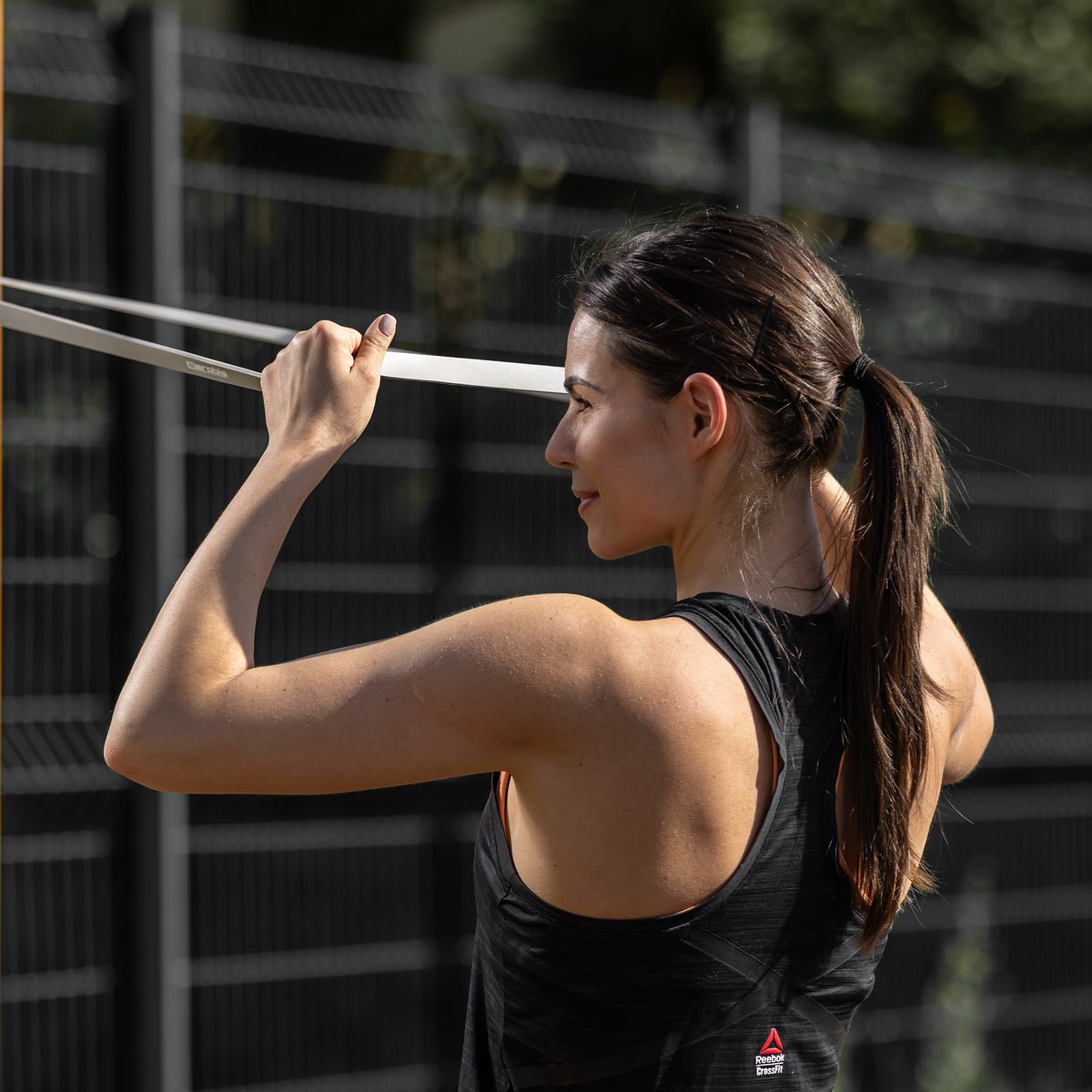
- Band pull-aparts (15 reps). Hold a light band at shoulder height and pull it apart until it touches your chest to wake up the mid-back and rear shoulders.
- Band external rotations (12 per arm). Elbow pinned to your side, rotate your forearm out against a light band to switch on the rotator cuff before any pressing.
- Banded hip hinge or good morning (12 reps). Stand on a band, hinge at the hips and squeeze your glutes to fire up the posterior chain.
- Rotational band press (10 per side). Anchor a band at chest height, press out and rotate gently to prepare your core to resist and transfer force.
- A few crisp jumps or explosive presses (30 seconds). Finish with a handful of light, fast reps to switch the nervous system to a higher gear.
That is roughly 8 to 10 minutes of focused prep. If you are short on time, keep the raise phase, the leg swings, the band pull-aparts and one explosive drill - that minimum still covers temperature, mobility and activation.
Why a Resistance Band Is the Perfect Warm-Up Tool
You can warm up with nothing but your bodyweight, but a band turns a decent warm up into a great one. Light, controlled tension lets you feel a muscle switch on - especially the small stabilisers around the shoulders and hips that bodyweight moves tend to miss. Bands also travel anywhere, so your warm up is identical whether you are at home, in the gym or in a hotel room.
A set of aerobis Premium Powerbands is ideal for this. The latex-free silicone loops are each 100 cm long and 4 mm thick, and come in four resistances so you can match the load to the drill:
- Light - 10 mm wide, around 10 kg, perfect for pull-aparts, rotator cuff work and glute activation.
- Medium - 20 mm wide, around 20 kg, for hinges, rows and rotational presses.
- Heavy - 30 mm wide, around 30 kg, for banded squats and heavier activation.
- Very Heavy - 40 mm wide, around 40 kg, when you want to add real load to your prep.
Because each band stretches up to 300 %, you fine-tune the resistance just by changing how far you stand from the anchor. For warm-up work you will mostly reach for the lightest band, since the point is to activate muscles, not fatigue them. You will find every resistance level plus anchors and handles in the aerobis Powerbands collection.

Common Dynamic Warm Up Mistakes
Even a good routine falls flat if you make these classic errors:
- Holding long static stretches. Save the deep, held stretches for after training. Before you lift, keep moving.
- Going too hard. A warm up should leave you loose and ready, not breathless. If you need to recover from your warm up, you overcooked it.
- Rushing through the ranges. Half-range leg swings and shallow squats do not prepare a joint for full-range load. Take each drill through its complete range.
- Using the same warm up for everything. Match the movements to the session. Leg-day prep and upper-body prep should not look identical.
- Skipping activation. Raising your heart rate is only step one. If you never switch on the glutes and cuff, the big muscles do work the stabilisers should be sharing.
How to Adjust Your Warm Up to the Session
The principle of specificity applies to warming up just as much as to training. Before a heavy lower-body day, spend more time on hip openers, ankle mobility and glute activation. Before pressing and pulling, prioritise shoulder circles, band pull-aparts and rotator cuff work. Before anything explosive - sprints, jumps or heavy Olympic-style lifts - add a longer potentiation phase with a few progressively faster reps. On a cold morning, give yourself an extra couple of minutes in the raise phase, because muscle temperature climbs more slowly when the room is cold.
The framework stays the same every time: raise your temperature, mobilise and activate the joints and muscles you are about to use, then potentiate with a few crisp reps. Only the specific drills change.
The Bottom Line
A dynamic warm up is not wasted time or a box to tick. It is 10 minutes that make every following minute better - more force, more control, more range and a much lower chance of tweaking something. Build the habit of moving before you load, keep a light band in your bag for instant activation anywhere, and treat your warm up as the first working set of the session rather than the price of admission. Your body will pay you back on every rep. Ready to upgrade your prep? Grab a set of aerobis Powerbands and make your warm up count.



Leave a comment
All comments are moderated before being published.
This site is protected by hCaptcha and the hCaptcha Privacy Policy and Terms of Service apply.