

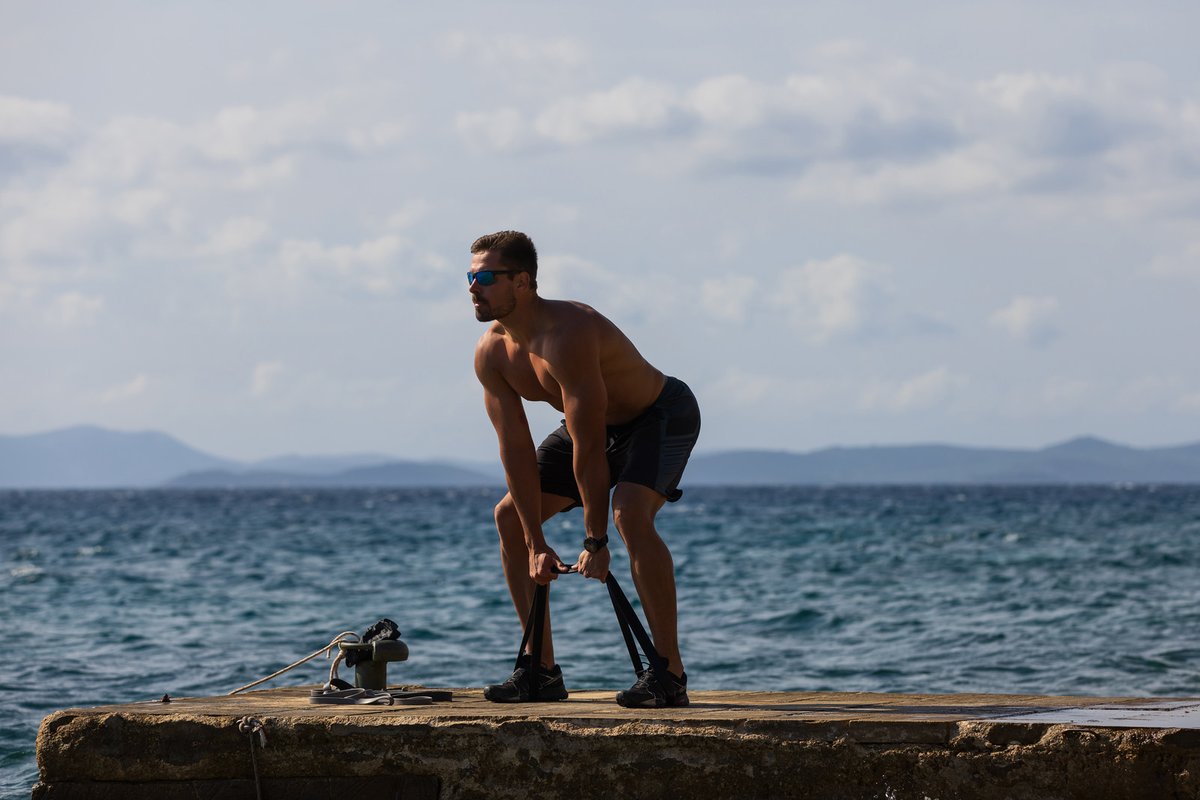
The hip hinge is how you pick a bag off the floor without turning the lift into a squat. The Romanian deadlift trains that pattern on purpose: knees softly bent, spine long, hips travelling back until the hamstrings take the load. You do not need a barbell. A loop powerband gives a vertical pull that tracks along the thighs the same way a bar would.
A resistance band Romanian deadlift (banded RDL) is a two-foot hinge. It is not a squat, not a lunge, and not a single-leg balance drill. Both feet stay planted. You train the posterior chain through a hip-hinge pull, with elastic tension that rises as you stand tall.
Why the banded RDL belongs in your training
Most programmes already have a knee-dominant lift and a horizontal pull. What they lack is a clean hinge you can repeat with no plates and no rack. The banded RDL fills that gap.
A barbell RDL is heaviest when the hamstrings are longest and can feel easier at lockout. A band does the opposite. Tension is modest at the bottom and peaks at the top, where the glutes and hamstrings produce the most force. One 100 cm loop covers a hinge session at home or on the road. Use it as your main hinge for a block, or as a primer before you load a bar.
Keep the exercise in its lane. Rows are a horizontal pull for the upper back. Lunges split the stance and load one knee. Squats change level with hips and knees together. A single-leg deadlift adds balance. The banded RDL stays bilateral, knees soft, hands close to the legs.
Muscles trained
The primary work sits on the back of the thighs and hips.
- Hamstrings: they lengthen as the hips travel back and shorten as you stand. That long-to-short action is the point of a Romanian deadlift.
- Glutes: they finish hip extension. Because the band is longest at the top, glute tension peaks where a bar often feels light.
- Spinal erectors: they hold a long spine. They do not pull the band. They keep the trunk from rounding while the hips move.
The hardest part of each rep should sit near full hip extension. If the top feels easy, the band is too light or your stance is not creating enough stretch.
Primary setup: stand in the loop, hands inside the legs
This is the default banded RDL. Make it impossible to miss:
- Stand inside the loop. Step both feet into a continuous 100 cm powerband so the band lies flat under mid-foot, feet about hip-width. The loop stays closed under both feet through the middle. Do not stand on top of a flattened band with the ends free.

- Take both band parts in your hands inside your legs. Reach down between your feet and grip both sides of the loop so your hands sit inside the legs, close to the thighs. Soften both knees a few degrees and keep that angle.

Stand tall, centre the band under mid-foot, and take light tension before the first hinge. Under the heels the band can slip. Under the toes the pull drifts forward and the knees follow. Stack the ribs over the pelvis and brace.
Choose load by the hinge. Light is around 10 kg and suits learning. Medium is around 20 kg for most working sets once the spine stays long. Heavy is around 30 kg and Very Heavy around 40 kg when you can control the lowering phase. Each loop stretches up to 300%, so stance width and hand height also change the feel.
Optional: low anchor
Fix the band low behind you, step forward until you feel light tension, and hold the loop in front of the thighs so the hands still travel along the legs. This is not a pull-through. A pull-through threads the band between the legs on a more horizontal line. Here the path stays close to the thighs, like a bar. Use this when a floor loop is awkward. The primary floor setup above remains the default.
Step-by-step technique (primary)
- Stand tall inside the loop with both band parts in your hands inside the legs. Soften both knees. The band should already be under light tension.
- Brace the trunk. Keep the chest open without flaring the ribs.
- Push the hips straight back. Let the hands slide down the insides of the thighs. Keep the shins nearly vertical.
- Stop when the hamstrings are loaded and you can still hold a long spine. For most people that is around the knee or a little below. Do not chase the floor if the back starts to round.
- Push the floor away and bring the hips forward. The band should get harder as you rise.
- Finish tall with the glutes tight and the pelvis neutral. Do not lean back or throw the ribs up.

- Lower under control for about two to three seconds so the hamstrings stay in the work.
Breathe in as the hips travel back. Breathe out as you stand.
Variation: stand on the band for a different resistance
Once the primary in-loop setup feels solid, you can load the same powerband another way. Stand on the middle of the band and hold the two end loops outside your legs. That shortens the working length and changes how hard the band pulls through the hinge, so you get a different resistance curve without swapping to another band.
Same hip hinge. Same soft knees and long spine. Different grip geometry.
Side by side at the hinge:

Side by side at lockout:

Variation hinge close-up:

Variation lockout close-up:

Technique cues
- Primary: feet inside the loop, both band parts in the hands inside the legs.
- Hips back, not knees forward.
- Keep the same soft knee angle from start to finish.
- Long spine from the crown of the head to the tailbone.
- Hands stay close to the legs, as a bar would.
- Feel the hamstrings load before you stand up.
- Finish with glutes, not with a backbend.
Common mistakes
- The squat-RDL: the knees travel forward and the hips drop. Think hips to the wall behind you and keep the shins quiet.
- A rounded low back: the hands went lower than your mobility allows. Raise the end position. Depth is not the score.
- Locked knees: straight knees shift the drill toward a stiff-leg deadlift. Unlock them and hold that angle.
- A row with the arms: the elbows bend and the shoulders shrug. The band should move because the hips moved.
- An overextended lockout: the ribs flare and the low back takes the finish. Stand tall, squeeze the glutes, keep the pelvis level.
- A noisy base on the primary setup: the band sits under the heels, starts from slack, or leaves a gap under mid-foot. Recentre a continuous loop under both feet and take tension first.
- Too much band: if you cannot lower for two seconds, or the spine rounds on rep three, drop a level.
- The wrong cousin: one foot makes it a single-leg deadlift. Bent elbows make it a row. Dropped hips make it a squat. Reset to two feet, soft knees, hands on the thigh line.
Regressions and progressions
Make it easier
Start here if the hinge is new or the back wants to round.
- Practise a bodyweight hinge to a wall, then add the band when the hips travel back without the knees shooting forward.
- Use the Light loop (around 10 kg) or a narrower stance so the band stretches less.
- Stop the hands at the knees. Own that range before you go lower.
Make it harder
Add load only after the lowering phase is quiet and the lockout is crisp.
- Move to Medium (around 20 kg), then Heavy (around 30 kg), then Very Heavy (around 40 kg).
- Widen the stance on the loop or hold the band lower so the top stretch is longer.
- Try the stand-on-band end-loop variation for a different resistance curve with the same loop.
- Pause one to two seconds at the bottom, or slow the lowering phase to three or four seconds.
A single-leg version is a different exercise. Use it later for balance work. It is not the next official step of this drill.
Simple programming
Train the banded RDL two to three times per week. Three to four sets of 8-12 controlled reps is enough for most people. Rest 60 to 90 seconds. The last two reps should be hard at the top while the spine stays long. If lockout is easy, stand a little wider on the band or take the next loop.
On a lower-body day it can be the main hip exercise. On a full-body day it sits well after a squat pattern and next to a row. Keep lunges and single-leg work in other slots so this session stays bilateral. Progress one variable at a time: cleaner range, slower lowering, then a stronger band.
Choose a band
Pick a loop that lets you hinge with a long spine and still meet a firm lockout. aerobis Premium Powerbands are 100 cm silicone loops, latex-free, with rounded edges. They stretch up to 300%. Light sits around 10 kg for learning. Medium sits around 20 kg for most working sets. Heavy around 30 kg and Very Heavy around 40 kg wait until the hinge is stable. One set covers the path from first clean reps to a hard lockout.

Leave a comment
All comments are moderated before being published.
This site is protected by hCaptcha and the hCaptcha Privacy Policy and Terms of Service apply.