

Hours of sitting, screen time and driving pull your shoulders forward and round your upper back. A few minutes with one resistance band strengthen the muscles that draw your shoulder blades back and down and open a tight chest. These resistance band posture exercises use one band. The face pull and the row also need a stable anchor, such as a pull-up bar, a rack or a sturdy post. With the anchor sling, the band stays securely in place.
Why resistance band posture exercises help
When your shoulders stay rolled forward, the chest and the front of the shoulders stay short. The muscles between the shoulder blades get too little practice: the rhomboids, the middle and lower trapezius, the rear delts and the rotator cuff. Resistance band upper back exercises train that back side and move each shoulder through a full range, so you can hold an upright position with less effort. These are useful exercises for rounded shoulders. If you have pain or an injury, check with a physio or doctor first.
Which band you need
Use Light (10 kg) for the pull apart, the pass-through, the W pull-down and the external rotation. When those reps stay smooth, Medium (20 kg) fits the row and the face pull. A closer grip adds tension. A wider grip makes the same band easier. The Premium Powerbands are large closed loops. Every band is 100 cm long and 4 mm thick, cast from latex-free silicone with rounded edges. It feels velvety and does not stick. The levels are Light (10 kg), Medium (20 kg), Heavy (30 kg) and Very Heavy (40 kg), up to 100 kg if you combine the set. This routine stays on Light and Medium.
1. Band pull apart

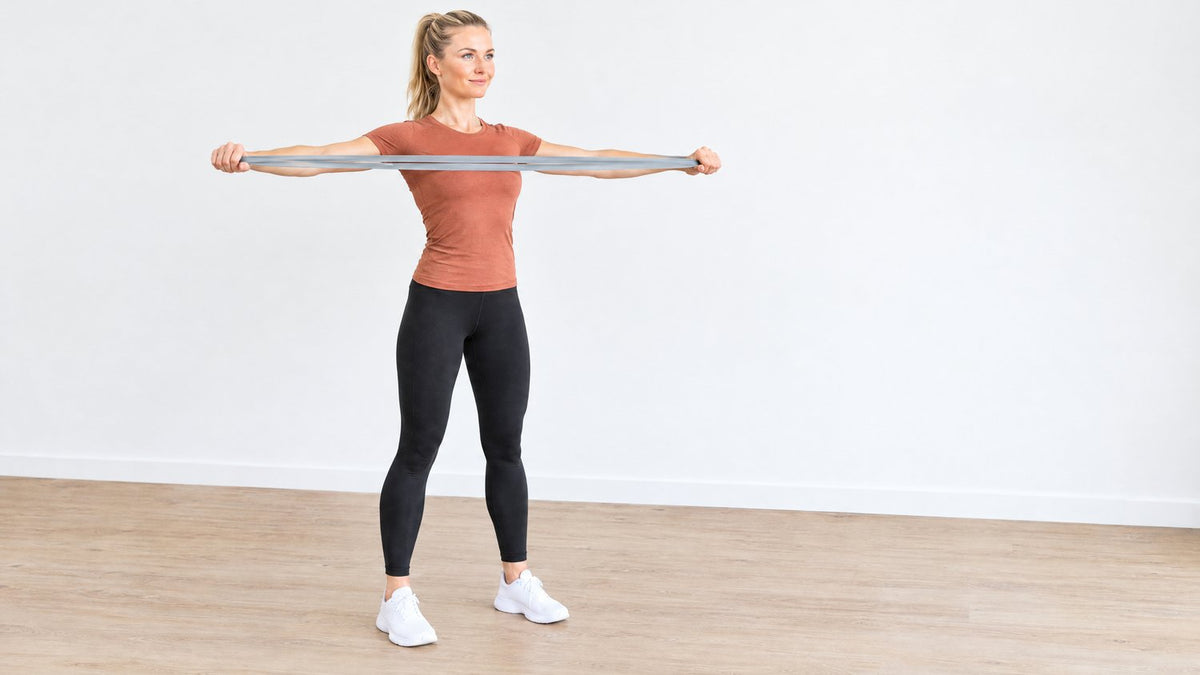
Setup: Hold the loop with both hands, palms down, and raise your arms to shoulder height. Choose a grip with light tension before you pull. Stand tall, ribs over your pelvis, knees soft.
Movement: Pull your hands apart until the band meets your chest. Draw your shoulder blades back and down as your arms open. Return your hands to the front under control.
Cues: Keep a small bend in the elbows. Do not let your shoulders rise toward your ears. Palms-up and diagonal variations, plus a simple way to program the move, are in our guide to the Band Pull Apart.
2. W pull-down
Setup: Hold the loop overhead with your arms straight and a grip that already stretches the band. Stand tall. Keep the band in front of your body.
Movement: Pull your elbows down and out until your hands are about level with your head, still in front of you. Your arms finish in a W. Your shoulder blades move down as you pull.
Cues: Lead with the elbows. Do not bend the wrists to find extra range. Never bring the band behind your neck. If your lower back arches, widen the grip or stay on Light (10 kg).
3. Shoulder pass-through

Setup: Stay on Light (10 kg) and take a wide grip. Hold the loop in front of your hips with straight arms.
Movement: Lift the band in a slow arc over your head until it is behind your back, then reverse the same path to your hips. Keep your arms straight.
Cues: This is mobility for the chest and the front of the shoulders. It is also called a shoulder dislocate. If the front of a shoulder pinches, widen your grip. Never force the range.
4. Face pull

Setup: Anchor the loop at about head height. Hold the band with both hands and step back until you feel light tension, arms reaching forward. Stand tall with soft knees.
Movement: Pull the band toward your forehead. Keep your elbows high and wide. Finish with your hands beside your ears and your shoulder blades drawn back and down.
Cues: Pause briefly, then return the band slowly. Do not drop the elbows toward your ribs. Anchor height, grip and the finer points are in our guide to face pulls with a resistance band.
5. External rotation with both hands

Setup: Use Light (10 kg) only. Hold the loop in both hands, palms up, elbows bent to about 90 degrees and held against your sides. Use a narrow grip and light tension.
Movement: Rotate both forearms outward so your hands move away from each other. Keep your elbows pinned to your sides. As you open, draw the shoulder blades slightly back.
Cues: This trains the rotator cuff. Some coaches call it the no-money drill. Do not move up from Light, or the elbows drift forward. Keep the shoulders down, away from your ears.
6. Standing band row with a pause

Setup: Anchor the loop at chest height. Hold the band with both hands and step back until it is taut, arms in front of you. Stand tall, knees soft.
Movement: Pull your elbows back, close to your body, until your hands are near your lower ribs. Pause for 2 seconds with your chest tall. Return until your arms are straight.
Cues: Do not shrug, and do not lean back to finish the pull. Keep your ribs down over your pelvis. Grip, anchor height and a full progression are in our guide to resistance band rows.
Common mistakes
- Shrugging toward your ears, so the neck works and the mid-back does less.
- Arching the lower back or lifting the ribs to look taller. Stack the ribs over the pelvis instead.
- A band that is too heavy, so the rep becomes a lean or a bounce.
- Fast reps that let the band snap back. The return is part of the exercise.
- Training the front and skipping the back: plenty of pressing, and very little pulling.
10-minute posture routine
Go through all six moves for 2 to 3 rounds. Do 12 to 15 reps of each move. For the pass-through, use 8 to 10 slow reps. Rest 30 to 60 s between rounds. Three sessions a week are enough. On the other days, leave the desk for one set each of the pull apart, the external rotation and the pass-through. Progress by narrowing your grip, or by moving to the next band once every rep stays smooth.
The Band Pull Apart guide goes further on this first move, with palms-up and diagonal variations and a simple way to program it. For a full shoulder session, follow the 8-move resistance band shoulder workout.
One band is enough to start. Find your resistance in the Premium Powerbands set, or see all Powerbands.


Leave a comment
All comments are moderated before being published.
This site is protected by hCaptcha and the hCaptcha Privacy Policy and Terms of Service apply.