

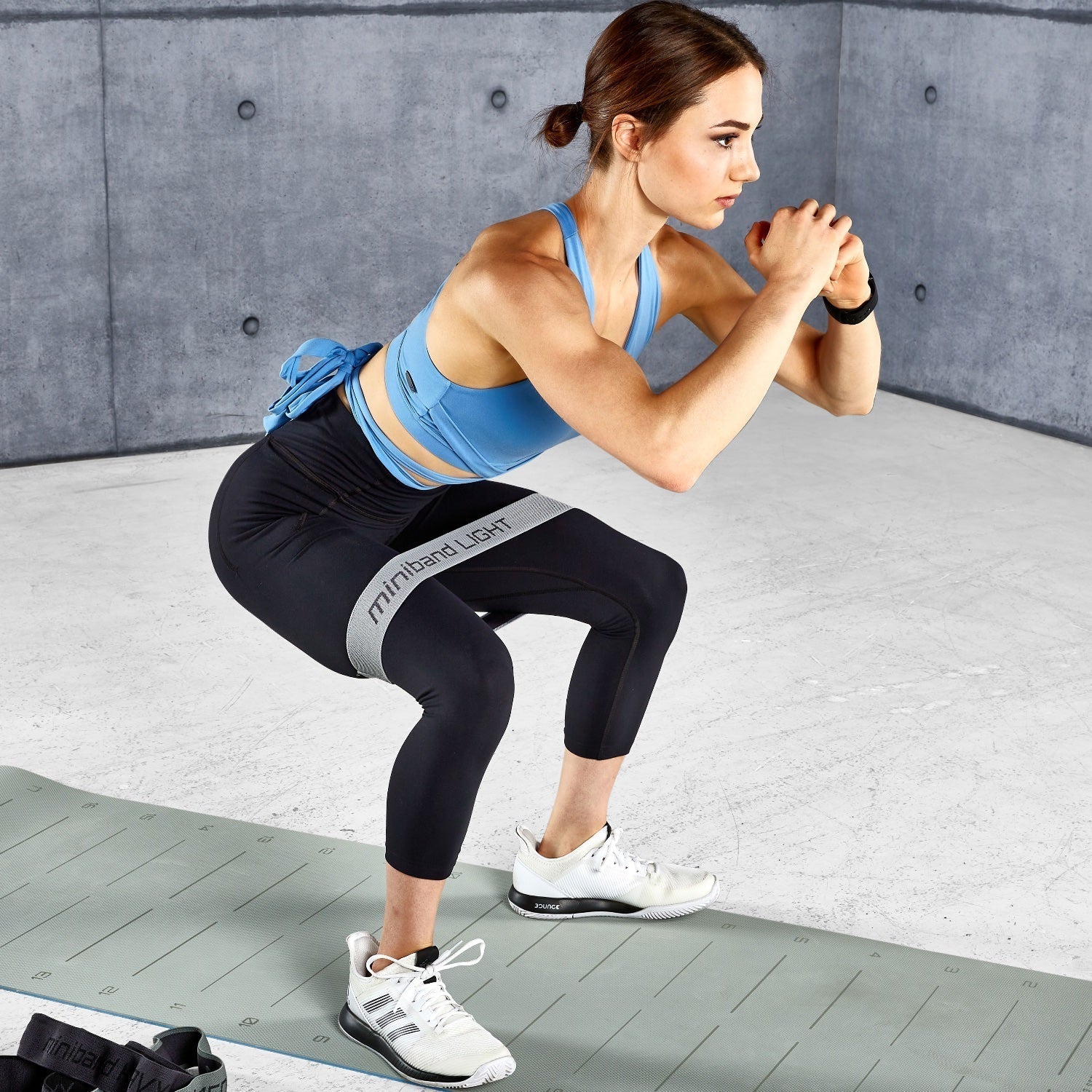
If your knees cave in on squats, your hips ache after a run, or your balance feels shaky on one leg, the fix might be one of the simplest moves in the gym. Lateral band walks are a low-impact, high-return exercise that light up the muscles on the side of your hip - the same muscles that keep your pelvis level, your knees tracking straight and your stride powerful. All you need is a small looped band and a metre of floor space, which makes them perfect for a warm-up, a rehab session or a dedicated glute day at home.
In this guide you will learn exactly what lateral band walks train, why they matter for strength and injury prevention, how to perform them with clean form, the most common mistakes to avoid, five variations to keep progressing, and how to program them into your week.
What Are Lateral Band Walks?
A lateral band walk is a closed-chain hip exercise. You loop a miniband around your legs - usually just above the knees or around the ankles - drop into a quarter squat, and step sideways while keeping constant tension on the band. Because the band resists every step, your hip muscles have to work hard to push the leg out and to control it on the way back in. It is often called a banded side step, a glute band walk or a crab walk, but the movement is the same: controlled sideways travel against elastic resistance.
Where you place the band changes things. A band above the knees is friendlier for beginners and puts the focus squarely on the hips. Moving the band down to the ankles lengthens the lever and dramatically increases the demand, so start high and progress low as you get stronger. A short, fabric miniband is the ideal tool here - it sits snugly on the leg and does not roll or ping the way a thin rubber loop can.
The Muscles Behind Lateral Band Walks
The star of the show is the gluteus medius, a fan-shaped muscle on the outside of your pelvis. Together with the gluteus minimus and tensor fasciae latae, it abducts the hip - pulling your leg out to the side - and, more importantly, stabilises your pelvis every time you stand on one leg. That happens on every step you take, every stair you climb and every single-leg landing in sport.
This is why lateral band walks are a physiotherapy staple. Research on gluteal activation shows that side-stepping against a band produces very high gluteus medius activity - up to roughly 80 % of a maximal contraction - which is greater than many other closed-chain moves such as clamshells, lunges and hops. You can read the electromyography breakdown in this Journal of Orthopaedic & Sports Physical Therapy study on gluteal muscle activation.
Why Lateral Band Walks Belong in Every Program
Most training happens in one direction: forward. We run, cycle, squat and lunge in the sagittal plane, and the muscles that move us side to side get neglected. That is a problem, because a weak gluteus medius lets the thigh bone rotate inward and the knee collapse - a pattern linked to runner's knee, IT-band pain and non-contact knee injuries.
Strengthening the hip abductors helps close that gap. A recent narrative review on the role of the monster walk and lateral band walk in lower-extremity rehabilitation highlights how these banded patterns are used to rebuild hip stability after injury and to prevent it in the first place. Clinicians also lean on targeted hip work for everyday knee and hip pain, as this overview of gluteus medius exercises for hip stability explains.
The payoff is not only injury prevention. Stronger, better-firing hips mean more stable knees under a heavy barbell, a more efficient running stride, sharper change-of-direction on the pitch and better balance as you age. Few exercises give you that much return for so little equipment.
How to Do Lateral Band Walks with Perfect Form
Getting the most out of lateral band walks is all about tension and control. Follow these steps:
- Loop a miniband just above your knees. Stand with your feet hip-width apart so there is already light tension on the band.
- Push your hips back and bend your knees into a quarter or half squat. Keep your chest up and your weight in your heels.
- Brace your core and keep your toes pointing forward, not turned out.
- Step one foot out to the side, driving the knee out against the band. Keep the movement slow and deliberate.
- Follow with the trailing foot, but only bring it back to hip-width - never let your feet click together, or you will lose tension.
- Take 8 to 12 controlled steps in one direction, then travel back the other way to work both hips evenly.
Keep your torso quiet. If your upper body is bobbing and swaying, the band is too heavy or you are rushing. Slow down and let the hips do the work.

Common Mistakes to Avoid
Lateral band walks look easy, which is exactly why they are so often done wrong. Watch out for these:
- Standing too tall. Losing the athletic squat position takes the load off the glutes. Stay low the whole set.
- Letting the knees cave in. The whole point is to resist that collapse - actively push the knees outward on every step.
- Feet snapping together. If the trailing foot travels all the way in, tension drops to zero. Keep constant width.
- Rushing. Fast, bouncy steps rob the hips of time under tension. Move slowly and feel the side of the hip working.
- Too much resistance, too soon. A band you cannot control forces compensations. Pick a resistance that lets you keep clean form for the full set.
5 Lateral Band Walk Variations to Keep Progressing
Once the basic version feels easy, keep the stimulus fresh with these progressions:
- Monster walk. Instead of pure sideways travel, step diagonally forward and out. This hits the glutes from a slightly different angle and adds a forward-drive component.
- Ankle-band walk. Move the band from above the knees to around the ankles. The longer lever sharply increases the demand on the hips.
- Double-band walk. Wear one miniband above the knees and a second around the ankles to challenge the hips at two points at once.
- Squat-walk hold. Sit deeper into the squat and stay there for the whole set. More time under tension, more burn.
- Forward and backward monster walk. Travel forward for several steps, then reverse. This challenges the hips in multiple directions and builds coordination.

How to Program Lateral Band Walks
Lateral band walks are versatile enough to fit almost anywhere in your training. As an activation drill, do 2 sets of 10 to 15 steps per direction before squats, deadlifts or a run - it wakes up the hips so the bigger muscles fire correctly. As dedicated strength work, aim for 3 to 4 sets of 12 to 20 steps per direction, resting about 45 to 60 seconds between sets and chasing a deep burn on the side of the hip.
Progress by moving up to a stronger band, shifting it lower down the leg, slowing your tempo or adding steps. Because bands are so joint-friendly, you can train this pattern two or three times a week without much soreness, making it ideal for consistent, long-term hip health.
Band choice matters, and this is where a fabric miniband beats a thin rubber loop: it grips the leg without rolling, digging in or snapping mid-set. The aerobis Miniband Set gives you four woven bands in one pouch, with resistances of 10 kg, 14 kg, 20 kg and 30 kg, each 33 cm long and stretchable up to 200 %. They are made in Europe from skin-friendly, Oeko-Tex certified polyester, are fully washable up to 30 °C and stay put around the thighs where rubber tends to creep. For lateral walks the 10 kg or 14 kg band is usually the right starting point; size up as your hips get stronger. You can find them alongside the rest of the elastic range in the aerobis resistance band collection.
The Bottom Line
Lateral band walks are proof that small, simple movements can deliver outsized results. Spend a few minutes a week loading your hips against a miniband and you will build a stronger gluteus medius, more stable knees, a more efficient stride and better balance - all with a piece of kit that fits in your pocket. Add them to your warm-up, your rehab plan or your glute day, focus on tension and control, and let those often-forgotten side-hip muscles finally pull their weight.

Leave a comment
All comments are moderated before being published.
This site is protected by hCaptcha and the hCaptcha Privacy Policy and Terms of Service apply.