

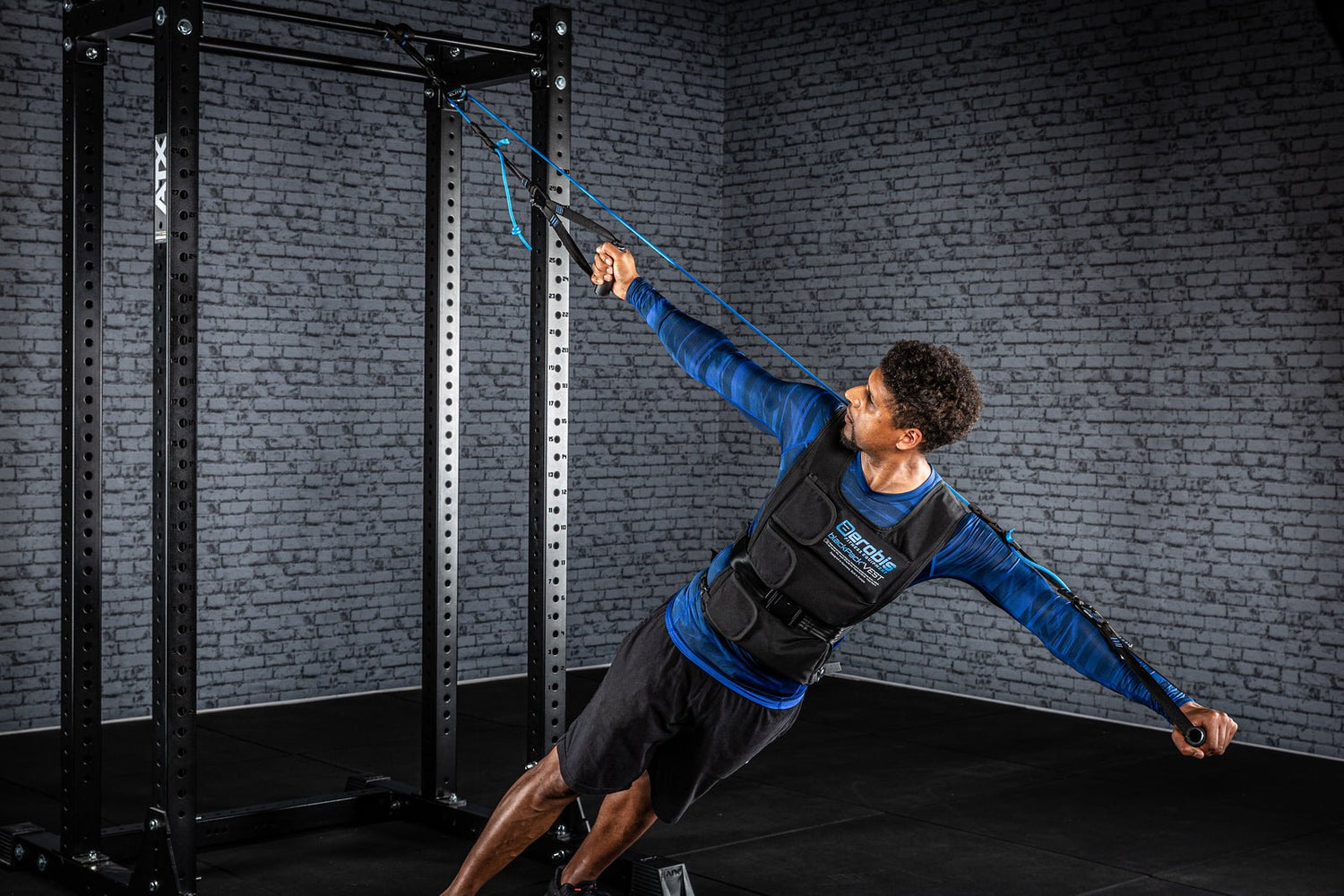
If you can hold a plank for two minutes and crunches no longer make you break a sweat, your midsection is asking for a bigger challenge. That is exactly where advanced core exercises come in. Instead of chasing more reps on the floor, you add instability, rotation and longer levers so your deep stabilizers have to work overtime. A sling trainer is one of the simplest ways to do that, because its free-moving rope forces you to fight movement in several directions at once. In this guide you get eight moves that will humble even a strong core, plus how to program them safely.
What actually counts as an advanced core exercise?
Your core is far more than a six-pack. It is a corset of muscles - the rectus abdominis, the internal and external obliques, the transverse abdominis and the deep spinal stabilizers - that keeps your spine stable while your arms and legs move. According to Harvard Health, a strong core supports posture, protects your lower back and transfers power during almost every rotational movement, from swinging a racket to carrying groceries up the stairs.
A beginner core exercise, like a floor crunch, trains one plane of motion on a stable surface. An advanced core exercise does at least one of three things: it removes a point of stability, it lengthens the lever between your hands and your feet, or it adds an anti-rotation or anti-extension demand. Do all three at once and even seasoned athletes start shaking. The goal is not to feel destroyed, it is to make your stabilizers fire harder while you stay in complete control.
Why advanced core exercises work better with instability
The reason a sling trainer feels so much harder than the floor is simple: the anchor point moves. A systematic review of unstable bodyweight training found that core activation ranged from moderate to very high, and that these exercises produced greater muscle activation than the same movements on a stable base. When your feet or hands hang from a free-moving rope, your body has to brake unwanted sway in every direction, so more muscle fibers get recruited to keep you aligned.
A separate systematic review of core muscle activity reached a similar conclusion: exercises that challenge balance and use free, unfixed implements consistently drive higher activity in the abdominal and lower-back muscles than machine-based movements. Instability is the shortcut to a harder core session without adding external load. That is why the ball-bearing deflection pulley on the aeroSling matters - it lets the rope glide freely on both sides, so nothing is locked in place and your core never gets a rest.

Single-handle mode: the key to anti-rotation training
Before the exercises, one setup detail makes several of them possible. The aeroSling normally gives you two independent handles, but many core moves work best when you pull or press against a single point. You do not need a different piece of kit for this - just clip the two handle carabiners together so both handles join into one connected grip. This is single-connect mode. With both hands on that one point (or one hand for single-arm work), the rope can pull your torso off to one side, and stopping that twist is exactly what trains your obliques as anti-rotators. For the moves that use your feet, simply place one foot in each of the two foot loops as usual.
8 advanced core exercises with a sling trainer
For every move, set the length noted below, brace your midsection as if you were about to be poked in the stomach, and keep your ribs pulled down so your lower back stays neutral. Move slowly enough that you feel your core, not momentum. Quality beats speed every single time.
- 1. Standing anti-rotation press. Clip the handles together (single-connect mode) and set the length so the grip sits at chest height. Stand side-on to the anchor so the rope runs out to your side, and hold the connected grip against your sternum with both hands. Brace, then press your arms straight out in front of your chest. The rope will try to rotate your torso toward the anchor; your job is to keep your shoulders and hips perfectly square. Hold the fully extended position for two seconds, then bring your hands back to your chest with control. Do all your reps on one side, then turn around and repeat facing the other way.
- 2. Kneeling fallout (anti-extension). Set the handles to roughly hip height and kneel facing away from the anchor, one handle in each hand, arms extended in front of you. Keep a straight line from your knees through your hips to your head, then slowly let your arms travel forward and overhead as your body leans toward the floor. Go only as far as you can while keeping that straight line - the moment your lower back starts to arch or your hips sag, you have gone too far. Pull your arms back down by bracing your abs and squeezing your glutes, not by yanking with your shoulders. Start with a short range and lengthen it as you get stronger.
- 3. Suspended pike. Set the foot loops low, about 30 cm off the floor, and put one foot in each loop. Start in a strong push-up plank with your hands under your shoulders and your body in a straight line. Keeping your legs as straight as you can, lift your hips up and back toward the ceiling until your body forms an inverted V, letting the rope swing your feet toward your hands. Pause at the top, then lower your hips back to the plank without letting your lower back drop. This trains the full length of the rectus abdominis.
- 4. Suspended knee tuck. Start in the same plank as the pike, feet in the loops. Instead of lifting your hips, draw both knees in toward your chest by rounding your lower back slightly, then extend your legs back to a straight plank under control. Keep your shoulders stacked over your hands the whole time. To bias the obliques, tuck your knees diagonally toward one elbow, alternating sides each rep.
- 5. Body saw. Set the foot loops low and rest your forearms on the floor in a plank, feet in the loops, elbows under your shoulders. Without bending anywhere, use your shoulders to push your body a few centimeters back from your elbows, then pull it forward again - a small, slow rocking motion. The longer your body is stretched away from your elbows, the harder your abs must fight to stop your hips from sagging. Keep the range tiny at first; even 10 cm is plenty when your form is honest.
- 6. Single-arm row hold. Grip one handle in one hand (or hold the single-connect grip one-handed), set it around chest height, and walk your feet forward so you lean back with your arm extended and body straight. Row yourself up by pulling your elbow down to your ribs, and pause for two seconds at the top. Because only one arm is loaded, the rope tries to twist your chest open toward the working side - resist it and keep both shoulders and hips level. It looks like a back exercise, but the real work is anti-rotation through your trunk. Match the reps on both arms.
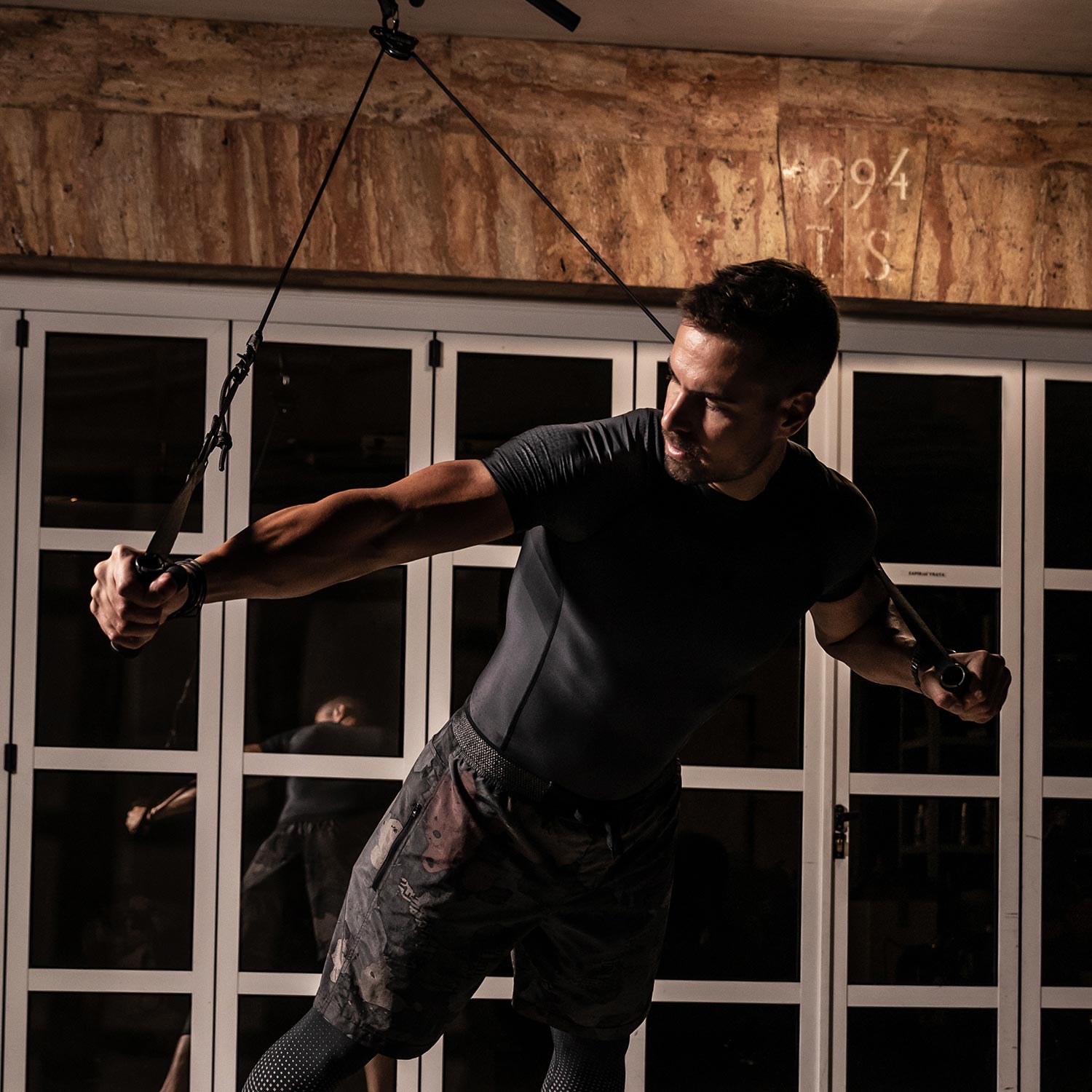
- 7. Sling chop. Clip the handles together and set the length high, above head height. Stand side-on to the anchor, both hands on the connected grip, arms extended up toward the anchor. Pull the grip down and across your body in a diagonal line to the opposite hip, like chopping wood, rotating through your trunk while your feet stay planted. Control the return by resisting as the rope pulls your arms back up - do not just let it snap back. Keep your arms fairly straight so the movement comes from your torso, not your elbows.
- 8. Suspended oblique crunch. Set the foot loops low, feet in the loops, and get into a side plank propped on one forearm with your body in a straight line. From there, crunch your top hip up toward your ribs, shortening the side of your waist, then lower back to the straight side plank. Because your feet hang in the loops, you are fighting to stay balanced on your side the whole time, which is why this makes such a demanding finisher. Complete your reps, then switch to the other forearm.

How to program advanced core exercises
More is not better here. Your core is working hard in every heavy squat, deadlift and carry you already do, so it does not need daily direct blasting. Two to three focused sessions per week is plenty. Pick three or four of the moves above, aim for 3 sets of 6 to 12 controlled reps (or 20 to 40 seconds for the holds and the body saw), and rest about 60 seconds between sets.
Progress by changing your body angle rather than adding weight. The more horizontal you get, or the further your feet move from the anchor, the harder every rep becomes. When a move feels easy for all your reps with perfect form, lengthen the lever, slow the tempo or add a pause at the hardest point. Research summarized by the American Council on Exercise shows that the exercises which best activate the abdominal muscles combine tension with a stability challenge, which is exactly what these sling variations deliver.
Common mistakes that limit your results
The first mistake is going too fast. Momentum lets your limbs do the work and lets your core off the hook, so slow down until you feel the stabilizers, not just your shoulders. The second is letting your lower back arch on anti-extension moves like the fallout and body saw. If your hips start to sag, shorten the range immediately. The third is holding your breath. Brace and exhale on the hardest part of each rep so your deep core stays switched on. Finally, do not skip the setup. A stable anchor and correctly adjusted length, from 76 cm up to 290 cm on the aeroSling, keep the movement smooth and safe.
The gear that makes it click
You can start with any reliable sling trainer, but a deflection-pulley model gives you the smoothest, most honest instability, and the connected-handle setup makes single-point work effortless. The aeroSling Tactical weighs just 0.8 kg, adjusts from 76 cm to 290 cm and uses a stealth rope rated to 1000 kg, so it sets up almost anywhere and takes everything you can throw at it. When the eight moves above stop challenging you, add the PowerSpring for another layer of instability, or browse the full sling trainer collection to find the model that fits your training.
Advanced core training is not about doing hundreds of crunches. It is about making a handful of hard, well-controlled moves even harder by removing stability and adding rotation. Master these eight exercises, program them a few times a week, and you will build a core that does its real job: keeping you strong, stable and injury-resistant in everything else you do.

Leave a comment
All comments are moderated before being published.
This site is protected by hCaptcha and the hCaptcha Privacy Policy and Terms of Service apply.