


If your push-up count has been stuck at the same 15 reps for months, the fix is usually not more reps. It is better push up variations. By changing your body angle, hand position, tempo and stability, you turn one basic exercise into a progression system that keeps challenging your chest, triceps, shoulders and core for years. No bench, no barbell, no gym membership needed.
Below you get 12 push up variations ordered from beginner to advanced, the three levers that make each one harder, and a simple plan for fitting them into your training week.
Why push up variations beat just adding reps
Once you can grind out 20 to 25 clean repetitions, extra reps mostly build muscular endurance. Strength and muscle growth need a higher relative load, and with bodyweight training the only way to get that is to change leverage. That is exactly what a good variation does: it shifts more of your bodyweight onto your arms, reduces your base of support, or lengthens the time your muscles stay under tension.
The push-up is also worth taking seriously as a health marker, not just a gym exercise. In a 10-year study of over 1100 active male firefighters published in JAMA Network Open, men who could complete 40 or more push-ups had a dramatically lower rate of cardiovascular events than men who managed 10 or fewer. You can read the full push-up capacity study here. Your push-up capacity is a cheap, surprisingly informative fitness test.
The three levers behind every push-up progression
Every variation on this list pulls at least one of these three levers:
- Body angle. Hands higher than your feet makes it easier. Feet higher than your hands makes it harder and shifts load toward your upper chest and shoulders.
- Hand position. Narrow hand placement increases activation in both the triceps and the pectoralis major compared with a wide base, as shown in this EMG comparison of push-up hand positions.
- Stability. Take away a stable floor and your trunk and shoulder stabilisers have to work far harder. A study on muscle activation during sling training found significantly higher activation across nearly all measured muscle groups compared with the same exercises on a stable surface.
Pick one lever at a time. Changing all three at once is how people end up with sore wrists and shoulders instead of progress.
4 beginner push up variations
Start here if a single strict floor push-up is not happening yet, or if you are returning after a long break.
- 1. Wall push-up. Hands on a wall at chest height, feet about 60 cm back. Groove the pattern: straight line from ear to ankle, elbows tucked to roughly 45 degrees. Build to 3 sets of 15.
- 2. Incline push-up. Hands on a sturdy table, then a chair, then a step. Lowering the surface height is the cleanest, most controllable progression in all of bodyweight training. Drop the height only when you own 3 sets of 12.
- 3. Knee push-up. Knees down, hips fully extended so your body stays in one line from knee to shoulder. The most common error here is letting the hips pike, which turns it into an arm exercise and skips the core work entirely.
- 4. Eccentric push-up. From the top of a full push-up, lower yourself over 5 seconds, drop to your knees and reset. You are far stronger lowering than pressing, so this builds the strength for your first strict rep faster than anything else. Do 5 to 6 slow negatives.
4 intermediate push up variations
These assume you can already do 10 or more strict push-ups from the floor.
- 5. Standard push-up. Hands slightly wider than shoulders, elbows at about 45 degrees, chest to within a fist of the floor, glutes and abs braced. Every variation below is a modification of this.
- 6. Diamond push-up. Index fingers and thumbs touching under your sternum. This is the highest-triceps variation on the list and a genuine step up in difficulty. If your elbows complain, widen the diamond slightly.
- 7. Tempo push-up. Three seconds down, one second pause at the bottom, one second up. Same exercise, roughly double the time under tension, and it exposes any part of the range where you cheat with momentum.
- 8. Feet-elevated push-up. Feet on a chair or box. The higher the feet, the more bodyweight lands on your arms and the more the emphasis shifts to your upper chest and front delts. Start at 30 cm and work up.

4 advanced push up variations
Do not touch these until your tempo push-ups are clean for 3 sets of 10.
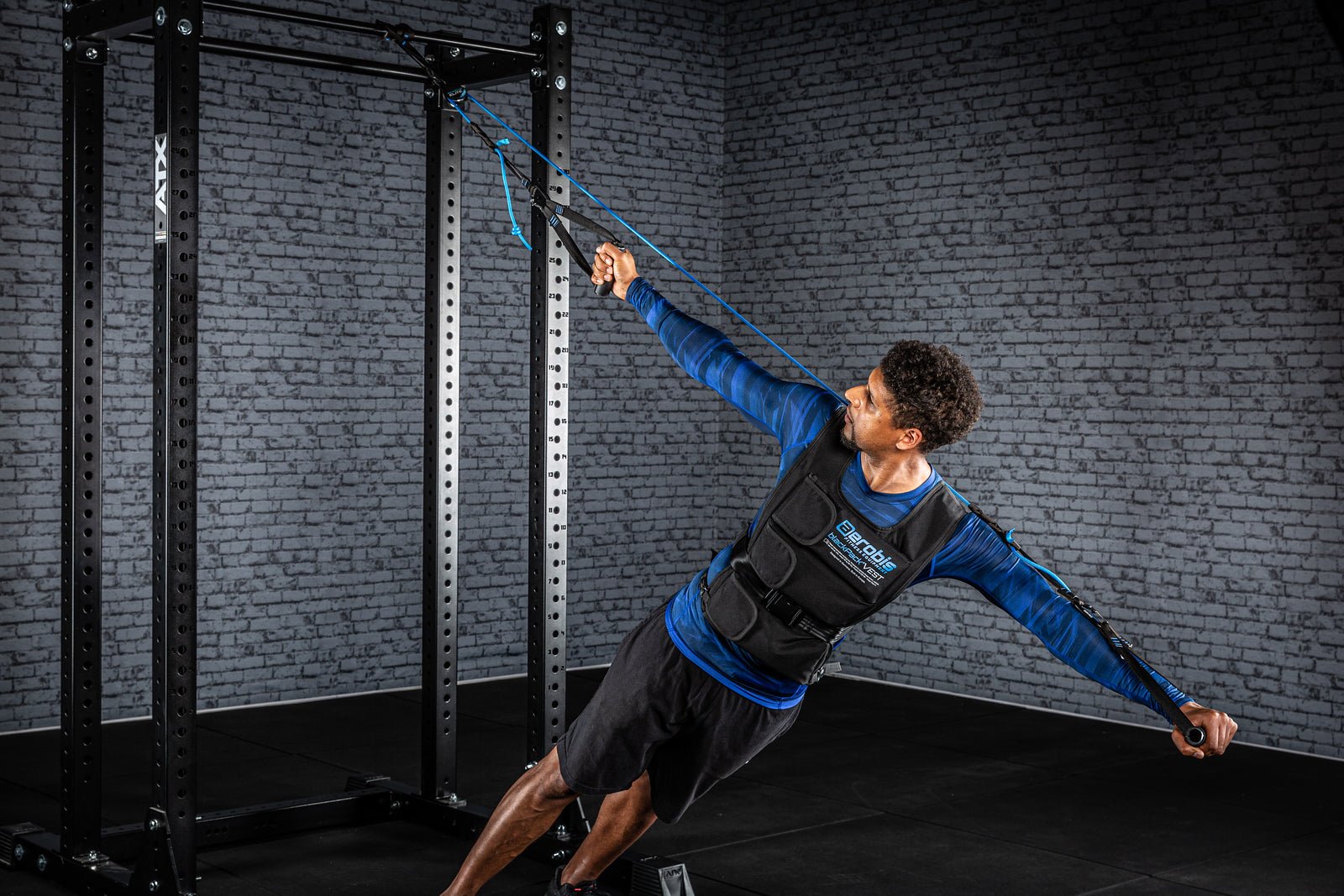
- 9. Sling trainer push-up. Hands in the handles of a sling trainer with the ropes hanging free. Because nothing holds the handles in place, your shoulder stabilisers and deep core have to control the path of the movement. Start with the handles high and walk your feet back only as you get stronger.
- 10. Archer push-up. Wide hand placement, then shift your bodyweight toward one hand while the other arm straightens out to the side. This is the most practical on-ramp to single-arm strength because you control exactly how much load the working arm takes.
- 11. Deficit push-up. Hands on two low blocks or parallettes so your chest can travel below hand level. More range of motion, more stretch under load, and much kinder to the wrists than flat-palm work.
- 12. One-arm push-up progression. Feet wide, one hand on the floor, other hand on a raised surface that you lower over weeks until it is a fingertip touch, then nothing. Expect this to take months rather than weeks, and keep the hips square the whole time.
How instability changes the push-up
Once floor push-ups get easy, the fastest way to make them hard again without adding external weight is to remove the stable surface. A scoping review of shoulder EMG activity across push-up variations found that unstable and rope-based conditions consistently produce the highest activation in the pressing muscles and the scapular stabilisers.
That is the idea behind our aeroSling ELITE sling trainer. The rope runs through a deflection pulley instead of being fixed at a single point, so both sides are connected and every asymmetry in your press shows up immediately. It handles up to 200 kg, adjusts from 190 cm to 290 cm, and packs down small enough to anchor on a door, a ceiling mount or a tree branch. If you want to compare models first, our full sling trainer collection lays out the differences between the ELITE and the full-black Tactical version.
Two practical tips for sling trainer push-ups: keep the handles just below chest height when you start, and resist the urge to let them drift outward at the bottom. The drift is the exercise telling you the load is too high.

How to program push up variations into your week
You do not need a complicated plan. Two or three pressing sessions per week is plenty, with at least one rest day between them.
- Pick one main variation you can do for 6 to 12 reps with 2 to 3 reps left in the tank. Do 3 to 5 sets.
- Add one easier back-off variation for 2 sets to failure at the end. Incline or knee push-ups work well here.
- Progress by reps first, then by variation. When you hit 3 sets of 12 clean reps, move to the next harder version and expect your reps to drop back to 6 or 7. That drop is the point.
- Balance your pulling. For every pressing set, do at least one rowing or pull-up set. Push-ups alone will round your shoulders forward over time.
4 mistakes that keep your push-ups stuck
- Sagging hips. If your lower back dips, your core gave up before your chest did. Squeeze your glutes hard and think about pulling your ribs down toward your hips.
- Elbows at 90 degrees. Flaring the elbows straight out to the sides is the single most common cause of push-up shoulder pain. Keep them at roughly 45 degrees so your arms form an arrow, not a T.
- Half repetitions. Chest to a fist off the floor or it does not count. Partial reps are how people convince themselves they can do 40 push-ups when they can really do 18.
- Skipping ahead. Jumping straight to one-arm attempts because they look impressive just teaches your body to compensate. Earn each step.
Where to start
Test yourself today: do as many strict push-ups as you can with a 3-second lowering phase and no rest at the top. Under 5 reps, start with the incline and eccentric work. Between 5 and 15, live in the intermediate block for the next 8 weeks. Over 15, move to tempo, feet-elevated and sling trainer variations.
Then pick one variation, log your sets, and check back in six weeks. The people who get strong at push-ups are almost never the ones doing the fanciest version. They are the ones who picked the right push up variations for their current level and stuck with them long enough to outgrow them.


Leave a comment
All comments are moderated before being published.
This site is protected by hCaptcha and the hCaptcha Privacy Policy and Terms of Service apply.