

The Turkish get-up looks almost too simple to be impressive: you lie on the floor with a weight held overhead, then stand up without letting it drop. Load a kettlebell into your hand and try a single rep, though, and you will quickly understand why coaches call the Turkish get-up one of the most complete strength exercises ever invented. It trains your shoulders, core, hips and legs in one slow, deliberate movement, and it teaches your entire body to work as a single connected unit. In this guide you will learn exactly what the Turkish get-up is, which muscles it works, its biggest benefits, how to perform it step by step and how to program it into your training.
What Is the Turkish Get-Up?
The Turkish get-up (often shortened to TGU) is a full-body strength and stability exercise in which you move from lying flat on the ground to a standing position while keeping a weight locked out overhead the whole time. The lift has been around for well over a century and takes its name from old-school strongmen and wrestlers who used it to build durable, usable strength. According to the American Council on Exercise exercise library, the movement is deceptively simple looking but genuinely challenging to master, because it demands upper-body strength, shoulder stability and a strong core all at once.
Rather than one big motion, the Turkish get-up is really a sequence of controlled positions: the roll to your elbow, the press up to your hand, the hip bridge, the leg sweep to half-kneeling, and finally the stand. You then reverse every step to return to the floor. Because you pause and stabilise in each position, the exercise exposes weak links most other lifts hide.
Turkish Get-Up Muscles Worked
One of the reasons the Turkish get-up is so valued is that it recruits nearly every major muscle group in a single rep. Working from the top down, the main muscles involved are:
- Shoulders and rotator cuff: they stabilise the weight overhead and keep your arm locked out through every position change.
- Core and obliques: your midsection works continuously to resist rotation and keep your trunk tall and controlled.
- Glutes and hips: they drive the bridge and power the transition from the floor up to kneeling and standing.
- Lats and upper back: these support shoulder stability and help you maintain good posture under load.
- Quads and hamstrings: they carry the load through the lunge and the final stand.
Because so many muscles fire together, the TGU builds the kind of coordinated, real-world strength that isolation exercises simply cannot replicate. That whole-body demand is also what makes it such an effective conditioning tool when you string reps together.
Benefits of the Turkish Get-Up
Add the Turkish get-up to your routine and you get a lot of value from one movement:
- Total-body strength: legs, core and shoulders are all challenged in a single exercise, which makes the TGU incredibly time efficient.
- Shoulder stability and health: holding a load overhead through changing angles trains the small stabilising muscles that keep your shoulders resilient.
- Core strength and anti-rotation: your trunk has to resist twisting the entire time, building a genuinely strong midsection.
- Mobility with control: the get-up blends hip mobility with a stable spine, a combination that carries over to almost every other lift.
- Better grip and coordination: gripping and controlling a swinging load ties into the wider fitness gains seen with kettlebell training. A controlled trial published in BMC Geriatrics found that structured kettlebell work produced meaningful improvements in grip strength and functional capacity.
How to Do a Turkish Get-Up Step by Step
Learn the pattern with a light weight first, or even a shoe balanced on your fist, before you load up. Here is the get-up broken into clear steps for your right side:
-
Set up: lie on your back, hold the kettlebell in your right hand and press it straight up over your chest. Bend your right knee so the foot is flat, and spread your left arm and leg out at roughly 45 degrees.

-
Roll to elbow: punch the weight toward the ceiling and roll onto your left forearm, keeping your eyes on the bell.

-
Post to hand: press up from your forearm onto your left hand, lifting your chest tall.

-
Bridge: drive through your right foot and left hand to lift your hips high off the floor.

-
Sweep to kneel: slide your left leg back underneath you into a half-kneeling position, arm still locked overhead.

-
Stand: come up tall to a full standing position with the weight overhead.

- Reverse: retrace every step in reverse until you are lying flat again.
Move slowly and own each position. The Turkish get-up rewards control, not speed.

Common Turkish Get-Up Mistakes to Avoid
- Rushing the reps: speeding through the positions defeats the purpose. Slow down and stabilise at every stage.
- Losing the overhead arm: let your wrist bend or your arm drift forward and the shoulder loses its stable position. Keep the bell stacked over the joint.
- Taking your eyes off the weight: watch the kettlebell during the early steps to help you balance, then fix your gaze forward once you are standing.
- Going too heavy too soon: a wobbly, half-controlled get-up is a recipe for tweaked shoulders. Master the pattern before you chase load.
Choosing the Right Kettlebell Weight
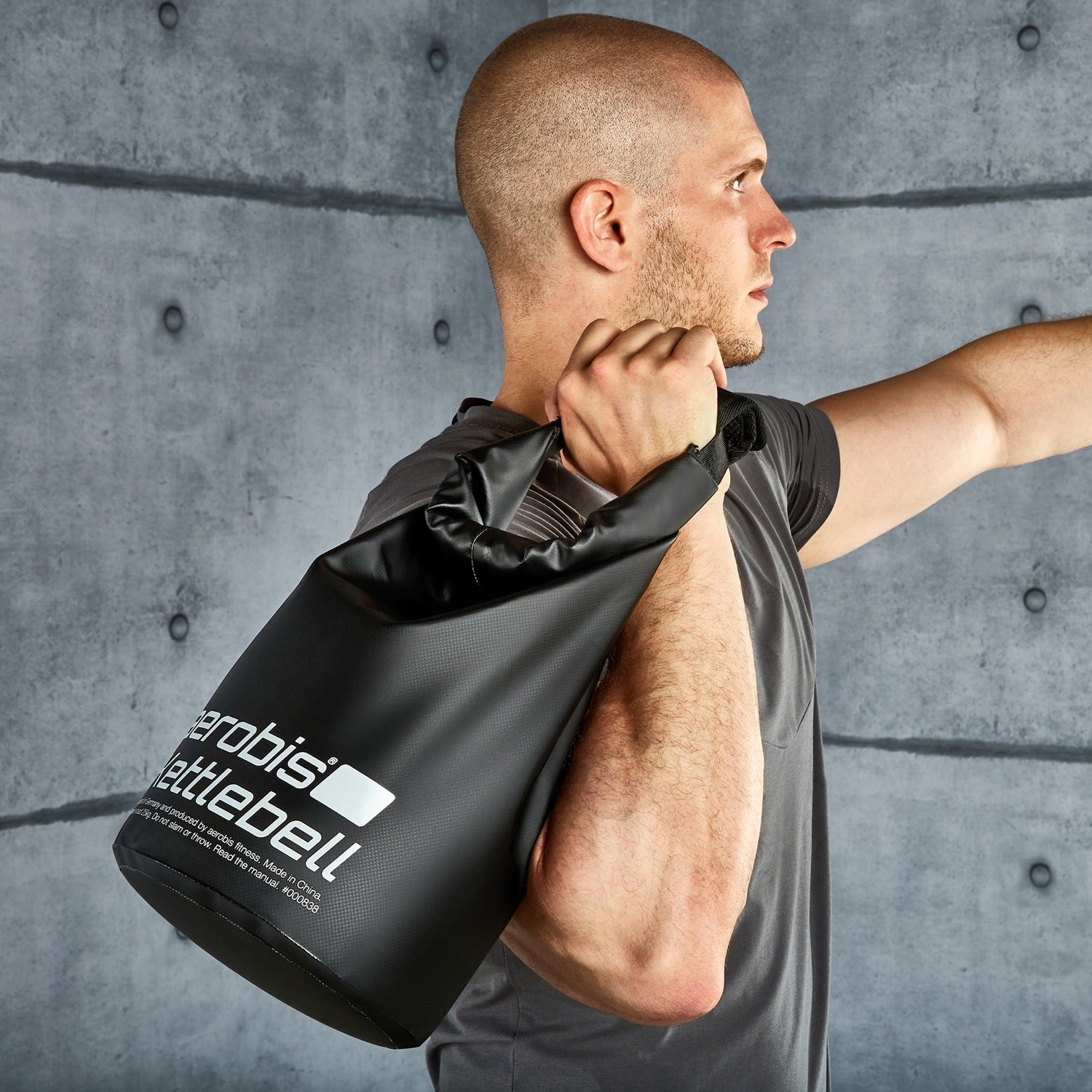
The Turkish get-up is humbling, so start lighter than your ego wants. Many beginners do well starting around 8 kg for men and 4 kg for women, then adding load only once every position feels solid. This is exactly where an adjustable tool shines. The aerobis adjustable kettlebell lets you dial in any weight from 1 kg to 25 kg by filling it with sand or steel shots, so you can practise the pattern light and progress in small steps without buying a whole rack of bells. It also folds down small enough to slip into hand luggage, which means your get-up practice travels with you.

How to Program the Turkish Get-Up
Because the TGU is slow and demanding, you do not need high reps to benefit. A good starting point is 2 to 4 controlled reps per side, done for a few sets. You can use it in several ways: as part of a warm-up to switch on your shoulders and core, as a main strength exercise when you go heavier, or as a finisher paired with lighter conditioning work. As a general kettlebell resource, Healthline notes that these full-body movements blend strength, cardio and coordination in one efficient session, which is why a single kettlebell goes such a long way.
Train the get-up 1 to 2 times per week alongside other movements like swings, squats and presses and you will build strength that shows up everywhere else. Ready to get started? Explore the full aerobis Weights collection to find the adjustable kettlebell and everything else you need to train the Turkish get-up at home, in the gym or on the road.


Leave a comment
All comments are moderated before being published.
This site is protected by hCaptcha and the hCaptcha Privacy Policy and Terms of Service apply.