

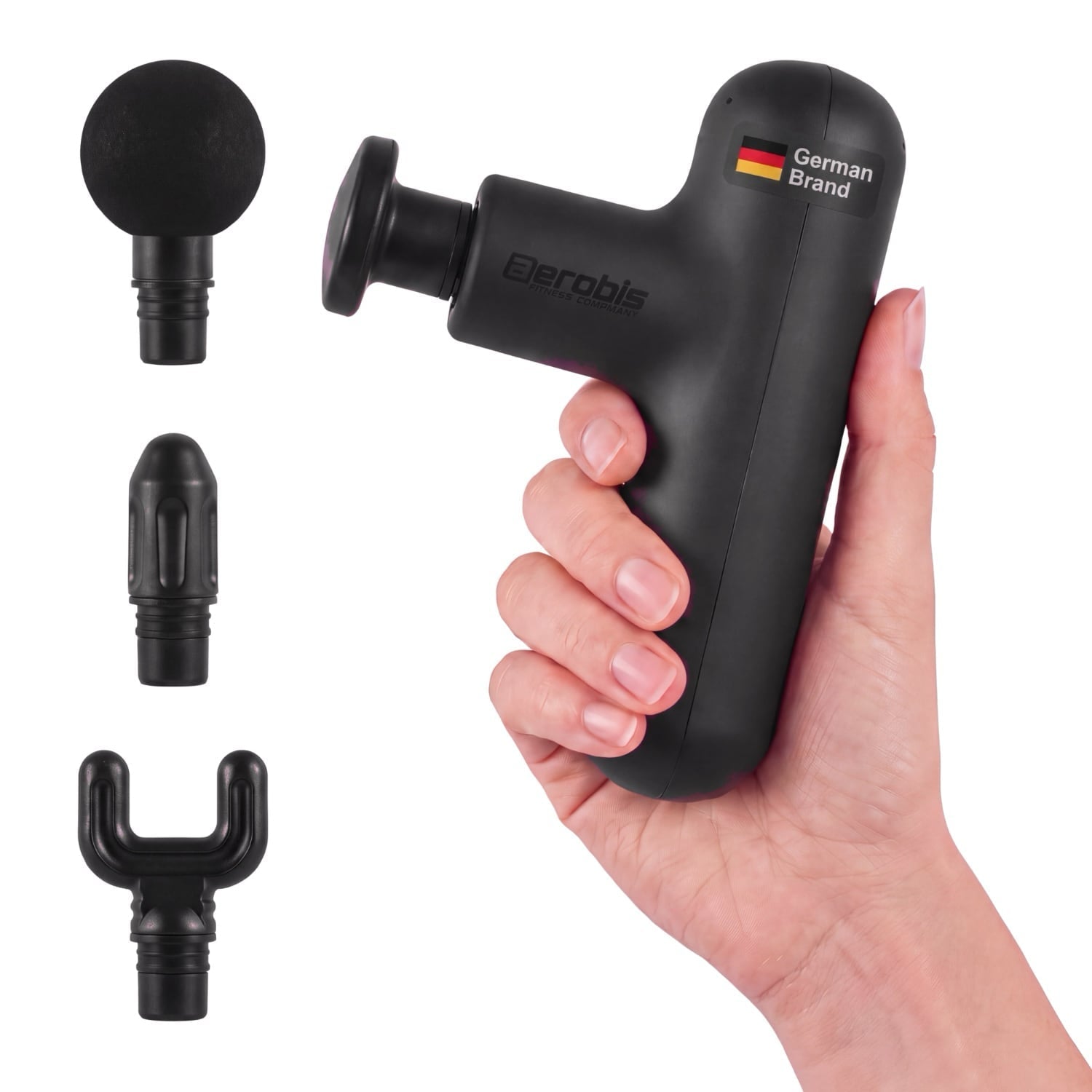
You can train the legs hard. If they stay glued and sore for three days, the next session is a negotiation. A fascia massage gun will not rebuild tissue for you. It will get blood moving, take the sting down and give you a usable range again. That is the job of a mini massage gun for athletes: a small, quiet tool you actually use because it lives in the bag, not in a drawer.
Most recovery kit fails for a boring reason. It is loud, heavy or awkward to reach your own back, so it stays on the shelf after week two. The useful test is whether you still pick it up on a Thursday night when the quads feel like rope.
What a fascia massage gun actually does
Fascia is the connective web around muscle. After heavy eccentrics, long runs or a cramped travel day it can feel sticky. You lose clean knee travel in the squat. The calf will not let the ankle open. Percussion sends fast, small pulses into that tissue. Local blood flow rises. Muscle spindles quiet down a little. Stiffness often drops enough that the next warm-up does not start from zero.
Be honest about the research. Short passes often give an immediate range bump around 10 %. Soreness relief is real in the moment and mixed over 24 h to 72 h. Strength numbers barely move. Use the gun to feel and move better, not to replace sleep, food or an easy day.
A 6 mm stroke is not a clinic hammer. That is the point. Tissue should accept the pulse, not brace against it. You rarely need 100 % of the motor. Most athletes live on the lower two of four levels and only climb when a big, fresh muscle asks for it.
Why the mini format wins for athletes
A full-size gun looks serious in a locker. It also eats a third of the backpack and announces itself through a hotel wall. A compact unit at 16 x 9 x 5 cm and 380 g slides next to the shoes. One button. USB-C. A 2000 mAh pack that lasts up to 16 h of real use, which in athlete life means weeks, not a single weekend.
Quiet matters more than people admit. You can run a pass while a roommate sleeps, in a physio corner or in the van after a race. If the tool is 35 % louder than it needs to be, you stop using it in shared spaces. Then it becomes a paperweight.
Self-application is the other test. You should reach calves, quads, glutes, lats and the meat of the upper back without a circus act. The aerobis mini is built for that: short body, four snap-on heads, matte grip you can hold when your hands are still salty.
Four heads, four jobs
Do not treat the heads as decoration. Swap them on purpose.
- Flat head. Large surfaces. Quads, hamstrings, lats, the meat of the back. Your default after a lower-body day.
- Ball head. General tissue. Glutes, calves, shoulders. Good when you want coverage without a sharp point.
- Cone head. Small, stubborn spots in a muscle belly. Use it briefly. If you have to grimace, you are on a nerve or too deep.
- U head. Alongside the neck muscles and around bigger tendons. Stay off the spine and the front of the throat.
Start every new area on the flat or ball head at level 1. Earn the cone. Never park a pointed head on one knot for minutes. Keep the tool moving at about a slow walking pace over the muscle, roughly 2 cm to 3 cm per second.
Before training versus after
Same tool, two jobs. Mix them up and you either pre-fatigue a muscle or hammer tissue that wanted a down-shift.
Before: wake it up
Use 30 s to 45 s per muscle you are about to load. Level 1 or 2. Flat or ball head. Goal: blood and a bit of range, not a massage holiday. Finish at least 5 min before heavy or fast work. A long, hard pass right before a sprint or a max squat can take the snap out of the tissue.
After: settle it down
Wait until breathing is calm. Then 60 s to 90 s per large group that actually worked. Level 1 or 2. Slow glide. Distal to proximal if you like a simple rule: calf toward the knee, quad toward the hip. Total time 8 min to 12 min is plenty. More is not kinder. Some longer lab protocols look fine for jump recovery, and they also tend to raise next-day soreness when people camp on one spot.
The first 90 min after a hard session are a good window if you are already in the changing room. If you miss it, use the gun the next morning on the lowest level. Do not chase yesterday with a 15 min beatdown.
A simple 10 min map
You do not need a 20-step ritual. After a mixed session, this is enough:
- Calves, 60 s each, ball head, level 1.
- Quads, 90 s each, flat head, level 2.
- Hamstrings, 60 s each, flat head, level 1 or 2.
- Glutes, 60 s each, ball head, level 2.
- Lats or upper back, 60 s per side, flat head, level 1. Sit and reach across the body if you work alone.
That is about 10 min. If only the calves took the beating, skip the rest. Specific beats complete.
How different sports tend to use it
Runners and field athletes. Calves, shins' neighbouring muscle (not the sharp tibial edge), quads, hip flexors, glutes. Keep the U head off the Achilles tendon itself. Work the calf belly above it.
Lifters. Quads and glutes after squats. Lats and pec meat after pulling and pressing. A short cone pass on a stubborn spot in the glute or pec, then back to the flat head. Do not percussion the lower back bones or the front of the shoulder joint.
Cyclists and rowers. Quads, hip flexors, low-back muscle bellies beside the spine (never on the vertebrae), forearms for rowers. A little time on the neck sides after a long aero or catch position, U head, light, moving.
Desk days count as load. A 4 min evening pass on upper traps and pecs is legitimate recovery.
Rules that keep you out of trouble
- Muscle belly only. No spine, no joints, no kneecap, no shin bone, no collarbone, no front of the neck.
- Skip acute injuries, open skin, unexplained swelling, numbness, fever or a calf that feels hot and tight in a way you do not recognise. That is a clinician, not a gun.
- Pressure: let the head sit. If you are leaning your bodyweight into it, you are bruising, not treating.
- Pain scale: stay around 4 out of 10. Sharp, electric or dizzy means stop.
- One area, 90 s typical, 2 min absolute ceiling, and only while moving.
- Do not use it as a warm-up replacement. Move, then add 30 s of percussion if you want.
Bruising after a first week is common when people treat the gun like a jackhammer. Turn the level down. Shorten the pass. The tissue should feel warmer and a bit looser, not beaten.
The aerobis mini, in plain numbers
The aerobis Mini Massage Gun is a 380 g fascia massage gun with four levels (1400, 2000, 2500 and 3000 pulses per minute), a 6 mm stroke and four heads in the box. USB-C charging, LED on the pack, one button, almost quiet. You get the gun, the heads, the cable and a short manual. That is the whole kit. No app, no subscription, no theatre.
Use it because you can reach your own legs in a hotel room. Use it because 10 min after intervals is more realistic than booking a table. Leave it alone when you need sleep, an easy spin or a day off. A mini massage gun for athletes is a pocket tool for tissue that already did the work. It is not the work.
If the quads still feel like rope tomorrow, start at level 1, flat head, 60 s, and go train only if the range is clean. The gun is there to help you show up again. That is enough.

Leave a comment
All comments are moderated before being published.
This site is protected by hCaptcha and the hCaptcha Privacy Policy and Terms of Service apply.