

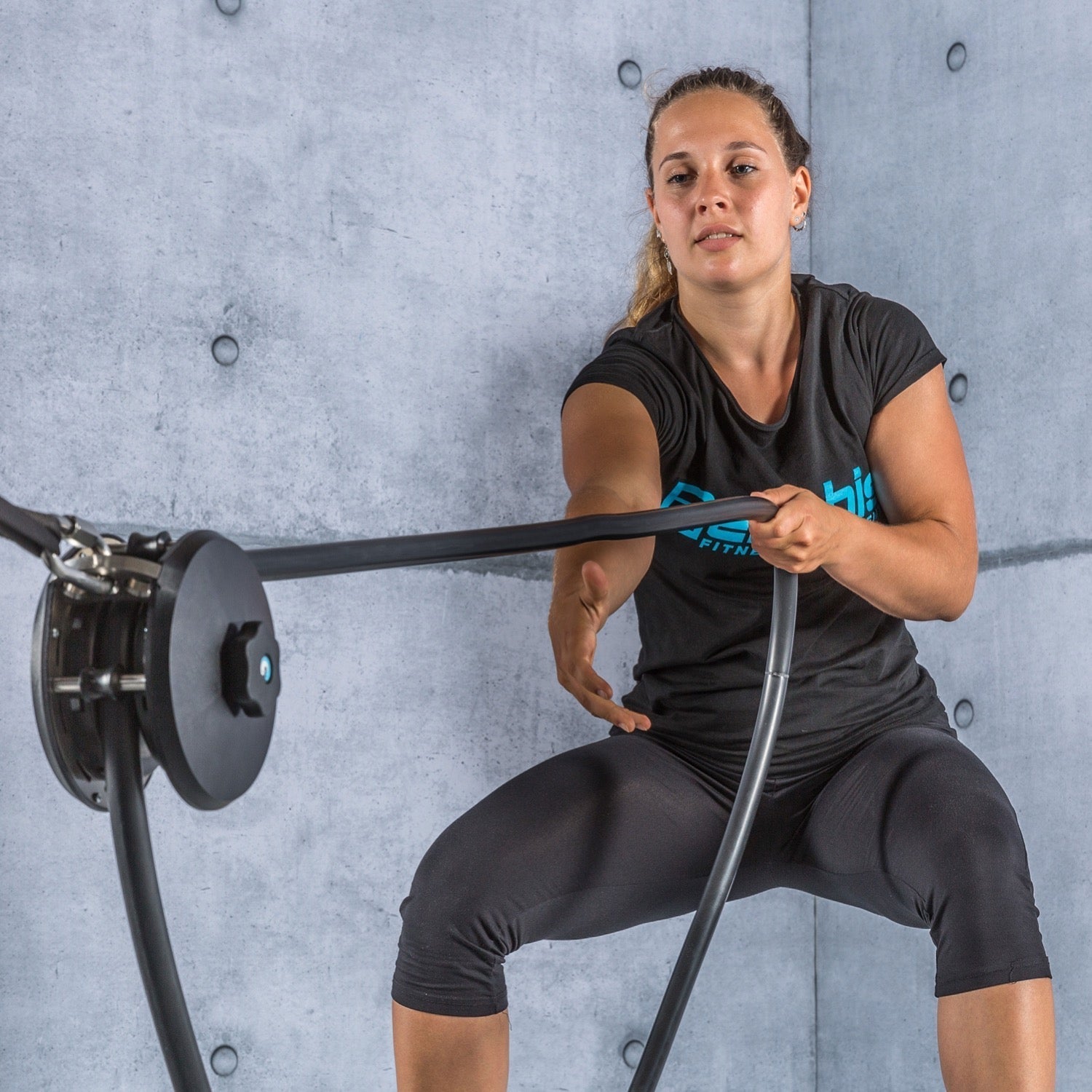
A rope trainer turns pulling into a complete, low-impact workout. Instead of lifting and lowering weights, you pull a continuous rope that only ever resists on the way in, so every rep is concentric, easy on the joints and instantly scalable. This guide explains how a rope trainer works, why the continuous-rope design is so effective and how to build your first full-body pulling workout with the revvll.
What is a rope trainer?
A rope trainer is a pulling machine built around a rope and a resistance unit. You fix it to a wall, a rack or a sturdy anchor, grab the handle and pull the rope towards you hand over hand. A brake inside the unit creates smooth, adjustable resistance, and the rope feeds back on its own, so it never runs out and you can keep pulling for as long as you like.
Because the resistance only works in the pulling direction, there is no heavy lowering phase and no eccentric load. That makes a rope trainer remarkably joint-friendly while still building serious pulling strength and cardio. The revvll rope trainers are German-engineered and let you dial the resistance from a gentle warm-up up to a brutal finisher.

Why train with a rope trainer?
- Joint-friendly by design: concentric-only pulling means no impact and no heavy eccentric load, so your joints and tendons stay happy.
- Strength and cardio in one: pull slowly and heavy for maximum strength, or fast and light for a lung-burning conditioning session.
- Infinitely scalable: turn a dial to change the resistance, so the same machine suits rehab, beginners and elite athletes.
- Pulling power for a strong back: rowing, lat and grip work that most home setups simply cannot deliver.
- Quiet and space-saving: no plates and no noise, and it mounts neatly to a wall or rack.
The best rope trainer exercises
Keep your core braced and pull with your back, not just your arms. Start with light resistance to master the movement, then add load.
1. Standing row (back and biceps)
Stand facing the unit, hinge slightly at the hips and pull the handle towards your waist. Squeeze your shoulder blades together, then let the rope feed back under control.
2. Kneeling lat pull (lats and core)
Kneel below the anchor and pull the rope down towards your chest with straight-ish arms. Keep your core tight so the work stays in your back.
3. Sprint pull (conditioning)
Lower the resistance and pull as fast as you can for 20 to 40 seconds. Hand over hand, no pauses, until your lungs are on fire.

4. Squat-to-pull (full body)
Start in a quarter squat, drive up through your legs and finish with a strong row. A great total-body power move.
5. Face pull (rear delts and posture)
Pull the handle towards your forehead with high elbows. Perfect for shoulder health and undoing hours at a desk.
A simple full-body rope trainer workout
Do this circuit 3 to 4 times. Rest 30 to 60 seconds between exercises and about 2 minutes between rounds.
- Standing row - 12 to 15 reps
- Kneeling lat pull - 12 to 15 reps
- Squat-to-pull - 10 to 12 reps
- Face pull - 15 to 20 reps
- Sprint pull - 30 seconds all out
Beginners should start with low resistance and fewer rounds. As you get stronger, add resistance or slow down the pull to build more strength.

Tips for getting started
- Mount the unit at chest to head height for the widest range of exercises.
- Pull with your back and legs, not just your arms, to protect your elbows.
- Keep light tension on the rope so it feeds back smoothly every rep.
- Start each session light as a warm-up, then increase the resistance.
Want to round out your routine? Combine pulling work with bodyweight training on our sling trainers, add scalable resistance with resistance bands, or add eccentric strength work with our flywheel trainers.
Which revvll is right for you?
aerobis builds a full range of German-engineered rope trainers, so you can pick the resistance and build quality that fit your training.
- revvll ONE: the accessible all-rounder for home and studio, ideal for your first pulling workouts.
- revvll PRO: the high-end model with the widest resistance range for demanding athletes and pro use.
- Battle Boa: a portable rope resistance trainer for explosive, functional pulls anywhere.
Compare every model in the full rope trainer collection.
Frequently asked questions
Is a rope trainer good for beginners?
Yes. You set the resistance with a dial, so you can start as light as you like and progress at your own pace. The concentric-only movement is also easy to learn.
How often should I train with a rope trainer?
Two to four sessions per week works well. Because the training is low-impact, you can use it for both strength days and conditioning finishers.
Is rope training really joint-friendly?
Yes. There is no impact and no heavy eccentric (lowering) phase, so the load on your joints and tendons stays low while you still build strength and cardio.
Can a rope trainer replace weights?
For pulling strength, back development and conditioning it is a superb, low-impact alternative. Many athletes combine it with bodyweight and band training for a complete programme.
Looking for one fitness tool that does it all? A rope trainer delivers low-impact pulling strength and cardio in one - see every model in our rope trainer collection.


Leave a comment
All comments are moderated before being published.
This site is protected by hCaptcha and the hCaptcha Privacy Policy and Terms of Service apply.