

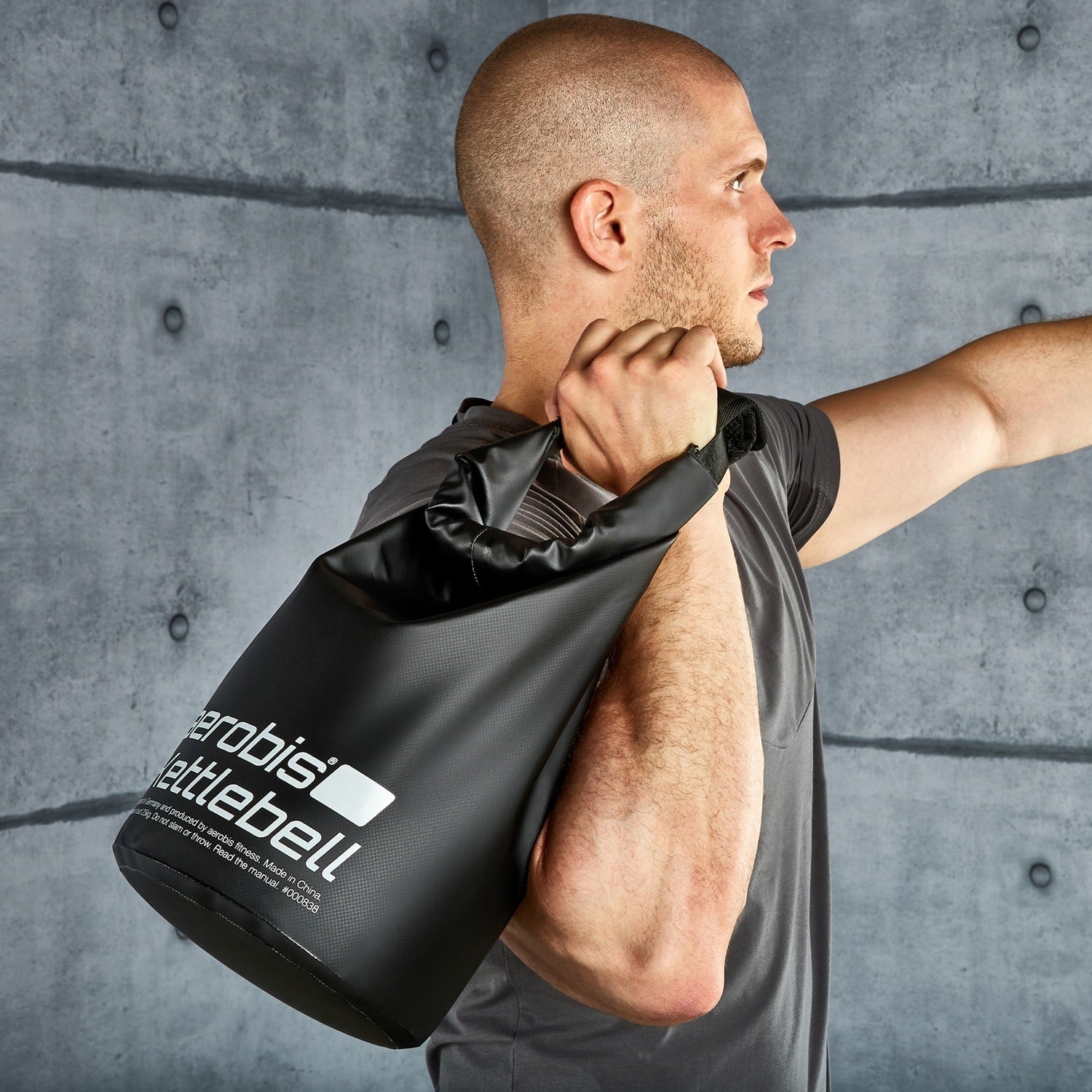
If you could only add one exercise to your training this year, the farmers carry would be a smart pick. You pick up something heavy, you walk, you put it down. That is the whole movement - and yet it hammers your grip, your core, your posture and your legs all at once. No complicated setup, no learning curve, no excuses. Whether you train at home, in the gym or in a park, the farmers carry (also called the farmers walk) turns a single kettlebell or sandbag into a genuine full-body workout.
In this guide you will learn what the farmers carry is, which muscles it works, why it is so effective, how to do it with clean technique, and how to program it into your week. Let's get walking.
What is a farmers carry?
The farmers carry is a loaded carry: you hold a weight in each hand (or one weight on one side), brace your midsection and walk in a straight line for a set distance or time. The name comes from farm life, where hauling heavy buckets and feed across a field was simply part of the day. The exercise recreates that demand in a controlled, repeatable way.
What makes it special is that the load never stops challenging you. On a squat or a press, there are easy moments in the range of motion. During a carry, every single step forces your body to resist the pull of the weight. That constant tension is exactly why coaches keep coming back to it, and why it fits beginners and advanced athletes alike.
Muscles worked during the farmers walk
People often assume a carry is "just" grip work. In reality it is one of the most complete movements you can do. Here is what fires when you walk with load:
- Grip and forearms: your finger flexors and forearms work overtime to hold on, which is why the farmers carry is one of the best grip builders around.
- Core: your obliques, deep abdominal muscles and lower back contract to keep your torso upright and stop you from tipping toward the weight.
- Upper back and shoulders: your traps, rhomboids and shoulder stabilisers hold everything in place under a heavy pull.
- Legs and hips: glutes, hamstrings, quads and calves drive each step and keep your stride stable.
A study published in the peer-reviewed literature on loaded carries confirmed high muscle activation across the trunk and shoulder girdle during carry patterns, underlining just how full-body this simple movement really is.

The benefits: why the farmers carry works
Beyond building muscle, the carry delivers benefits that transfer directly to sport and everyday life.
Serious grip strength. Grip is more than a party trick. Research consistently links stronger grip with better overall health outcomes, and a strong grip carries over to deadlifts, rows and pull-ups. Carrying heavy loads over distance trains your hands to produce and hold tension - the exact quality most lifters are missing.
A rock-solid core. Loaded carries train your core to resist movement rather than create it, which is precisely how your midsection works in real life. According to the National Strength and Conditioning Association, carries challenge the core more effectively than most isolated ab exercises while also improving posture and shoulder stability.
Better posture and joint stability. A further NSCA review found that loaded carries improve hip and trunk stability, which can reduce injury risk and support rehabilitation. Standing tall under load teaches your body to stack your ribs over your hips - the opposite of the slumped posture most of us fall into at a desk.
Real-world carryover. Hauling groceries, lifting a suitcase into an overhead bin, moving furniture - all of these are carries. Train the pattern and daily life gets easier.
How to do a farmers carry with perfect form
Technique is simple, but details matter. Follow these steps:
- Set up: place a weight on each side of your feet. A pair of kettlebells is ideal, but a single kettlebell or a sandbag also works.
- Pick it up: hinge at your hips, keep your back flat and grip the handles firmly. Stand up as if you were doing a deadlift.
- Brace: pull your shoulders down and back, take a deep breath and tighten your core as if bracing for a punch.
- Walk: take short, controlled steps in a straight line. Keep your chin level and your torso upright - do not lean.
- Set down: hinge at the hips again and place the weights down under control. Never just drop them.
Keep your ribs down, your gaze forward and your steps quiet. If the weight is pulling you into a side-bend, it is too heavy - reduce the load and rebuild.
Farmers carry variations to keep progressing
Once the basic carry feels solid, these variations add fresh challenges:
- Suitcase carry: hold a single weight on one side only. The uneven load forces your obliques to work hard to keep you upright - a superb anti-side-bend drill.
- Front rack carry: hold a kettlebell against your chest. This shifts the load higher and demands more from your upper back and core.
- Overhead carry: press a weight overhead and walk. This one is humbling and builds serious shoulder stability.
- Bear hug carry: hug a sandbag to your chest and walk. The shifting sand adds instability that lights up your deep core muscles.

How to program the farmers carry
Because the carry is measured by distance or time rather than reps, programming is refreshingly simple. A good starting point:
- For strength: use a heavy load you can hold for about 20 m to 30 m, and do 3 to 5 rounds with full rest between them.
- For conditioning and endurance: use a lighter load and walk for 40 s to 60 s per set, keeping rest short.
- Frequency: two or three carry sessions per week is plenty. Add them at the end of a workout as a finisher, or between strength sets to keep your heart rate up.
Progress by adding distance first, then weight. With an adjustable kettlebell you can nudge the load up in small steps, which makes long-term progress easy to manage. Aim to add a little each week rather than jumping straight to a maximum you cannot control.
Common mistakes to avoid
Keep these in mind so every step counts:
- Leaning or twisting: if you cannot stay tall, the weight is too heavy.
- Rushing your steps: speed-walking wrecks your posture. Slow, deliberate steps keep the tension where it belongs.
- Holding your breath the whole time: brace, but keep breathing in short, controlled bursts.
- Neglecting the pickup and set-down: most carry injuries happen at the ends. Treat both like a deadlift.
Getting started with the right equipment
The beauty of the farmers carry is how little you need. A single adjustable weight gets you started, and you can scale it as you get stronger. Our adjustable aerobis Kettlebell loads freely from 1 kg up to 25 kg, so beginners and experts can share the same tool - and it folds flat for travel. For bear hug carries and heavier loading, the aerobis Sandbag adjusts up to 30 kg with six grip handles for endless variation.
Explore the full range in our Weights collection and pick the tool that fits your training. Then load it up, stand tall and take your first steps - your grip, core and posture will thank you.

Leave a comment
All comments are moderated before being published.
This site is protected by hCaptcha and the hCaptcha Privacy Policy and Terms of Service apply.