

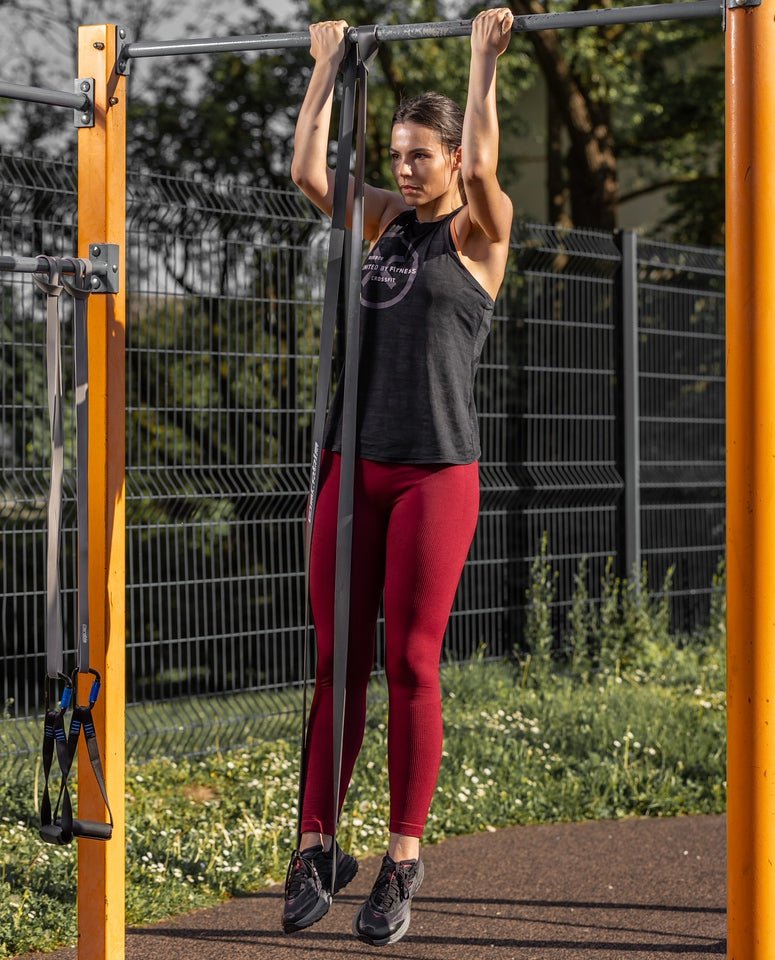
If your chin has never made it over the bar, you are not weak - you just need a smart head start. A pull-up assist band gives you exactly that: it takes a slice of your bodyweight off the bar so you can train the full pull-up movement long before you can do one unassisted. Loop a band around the bar, slip a foot or knee into it, and suddenly the strict pull-up goes from "impossible" to "challenging but doable". In this guide you will learn what a pull-up assist band is, how to use resistance bands for pull-ups, what size band to pick, and a simple progression that takes you from your first banded rep to your first clean bodyweight pull-up.
What is a pull-up assist band?
A pull-up assist band is a strong loop of elastic - in our case a latex-free silicone Powerband - that you anchor to the pull-up bar to support part of your bodyweight. When you stretch the band by stepping into it, it stores energy. At the bottom of the pull-up, where you are weakest and the band is stretched the most, it pushes you up hardest. As you rise toward the bar and the band shortens, the assistance fades and your muscles take over. That variable boost is the whole point: it helps you most exactly where most people get stuck, and it forces your back and arms to do real work at the top of the range.
Unlike a fixed assisted pull-up machine at the gym, a band costs little, weighs almost nothing, and fits in a bag. You can train at home, in the park, or anywhere you can hang from a bar.
Why banded pull-ups actually build strength
The pull-up is one of the best upper-body exercises there is. It is a compound pull that trains your latissimus dorsi (the big muscles that give your back its width), plus your biceps, forearms, rear shoulders, trapezius and core all at once. According to Healthline, regular pull-ups improve back and grip strength, support better posture and carry over to sports from climbing to tennis.
The problem is that a strict pull-up demands you move 100 % of your bodyweight from a dead hang. For most beginners that is simply too much load to train with any volume. A band fixes this by reducing the effective weight, so you can practise the exact same movement pattern with good form and enough repetitions to get stronger. Strength coaches treat the band-assisted pull-up as a true progression exercise rather than a shortcut - the fitness education body NASM lists it as the standard bridge toward unassisted reps. You keep the skill, the grip demand and the range of motion; you just dial down the resistance until your strength catches up.

How to use resistance bands for pull-ups, step by step
Setting up a pull-up assist band takes about ten seconds once you know the routine. Here is how to do it safely:
- Anchor the band. Pull one end of the loop through itself over the middle of the pull-up bar and cinch it tight, so it hangs down in a long loop (a girth hitch). Give it a firm tug to make sure it will not slide.
- Grip the bar. Take an overhand grip slightly wider than shoulder width. Squeeze the bar hard - grip is part of the exercise.
- Load the band. Pull the bottom of the loop down and place one foot in it for more stability, or a knee if you want a little less assistance. Keep the other leg tucked or crossed behind.
- Set your body. Hang with arms straight, shoulders pulled down and back, ribs down and core braced. Do not let the band catapult you - stay in control.
- Pull. Drive your elbows down toward your hips and lead with your chest until your chin clears the bar. Pause for a moment at the top.
- Lower slowly. Take 2 to 3 seconds to come back down to a full dead hang. The lowering phase builds enormous strength, so never just drop.
For a visual reference on foot placement and body position, the team at PureGym has a clear breakdown of the assisted pull-up setup. Two safety notes: always check that the band has no nicks or tears before loading it, and step out of the band carefully at the end of your set rather than letting it snap back.
What size resistance band do you need for pull-ups?
This is the question everyone asks, and the honest answer is: more than one. The amount of help a band gives depends on its width and thickness - a wider band stretches less for the same load, so it carries more of your weight. Our Premium Powerbands come as a set of 4, each 100 cm long and 4 mm thick, and that range is what lets you actually progress:
- Light - 10 mm wide, up to 10 kg of assistance. A gentle boost for your final reps or for tall, lighter trainees who are nearly there.
- Medium - 20 mm wide, up to 20 kg. A solid all-round choice once you can already grind out a rep or two.
- Heavy - 30 mm wide, up to 30 kg. The most popular starting band for many beginners.
- Very Heavy - 40 mm wide, up to 40 kg. Maximum support for your very first banded pull-ups, or for heavier trainees.
The rule of thumb: pick the band that lets you complete 5 to 8 clean reps with real effort on the last one. If you can rep out 15 with ease, the band is too thick and is doing the work for you. If you cannot reach 5, size up. Because each band stretches up to 300 %, you also get a built-in micro-progression - the deeper you load it, the more help you get.

A simple 6-week banded pull-up progression
You do not get pull-ups by grinding the same band forever. The goal is to remove assistance over time. Here is a straightforward plan you can run twice a week, leaving at least one rest day between sessions:
- Weeks 1 to 2: Use a band that gives you 6 to 8 solid reps. Do 4 sets, resting 90 seconds. Focus on a slow 3-second lowering phase every rep.
- Weeks 3 to 4: Add a fifth set, or switch to the next thinner band and aim for 5 reps per set. Add 2 to 3 slow negatives at the end - jump to the top and lower as slowly as you can.
- Weeks 5 to 6: Alternate sets between your current band and one step thinner. Finish each session by attempting 1 unassisted rep. The day it works, you are a pull-up athlete.
Round out your training with rows and dead hangs to build the grip and mid-back strength that pull-ups demand, and give your back 48 hours to recover between sessions.
Common mistakes to avoid
A few errors quietly stall most people's progress. Keep these in mind:
- Living on the thickest band. If you never reduce assistance, you never get closer to a real pull-up. Treat the band like training wheels you are trying to take off.
- Skipping the bottom. Half reps that never reach a full dead hang feel easier but skip the hardest, most valuable part of the range.
- Letting the band yank you up. Stay braced and controlled. If the band launches you, the muscles are not doing the work.
- Ignoring the negative. Slow lowering is where a lot of beginners build the strength for their first rep, so do not rush it.
Beyond pull-ups: more from your Powerbands
The best part about training with a pull-up assist band is that the same band does a hundred other jobs. Once it is off the bar, your Premium Powerbands become a full mobile gym: banded squats and deadlifts, chest presses, rows, shoulder work, glute activation and warm-ups - all with joint-friendly variable resistance that hits hardest at the strongest point of each movement. A single set covers everyone from your first workout to advanced strength training, and the whole kit fits in a bag for travel or the park.
If you want to build a complete elastic-resistance setup, browse the full Powerbands collection for heavier options, anchors and accessories that grow with you. Start with a band on the bar, chase that first pull-up, and you will have a training tool you keep using long after your chin clears the bar for the first time.

Leave a comment
All comments are moderated before being published.
This site is protected by hCaptcha and the hCaptcha Privacy Policy and Terms of Service apply.