

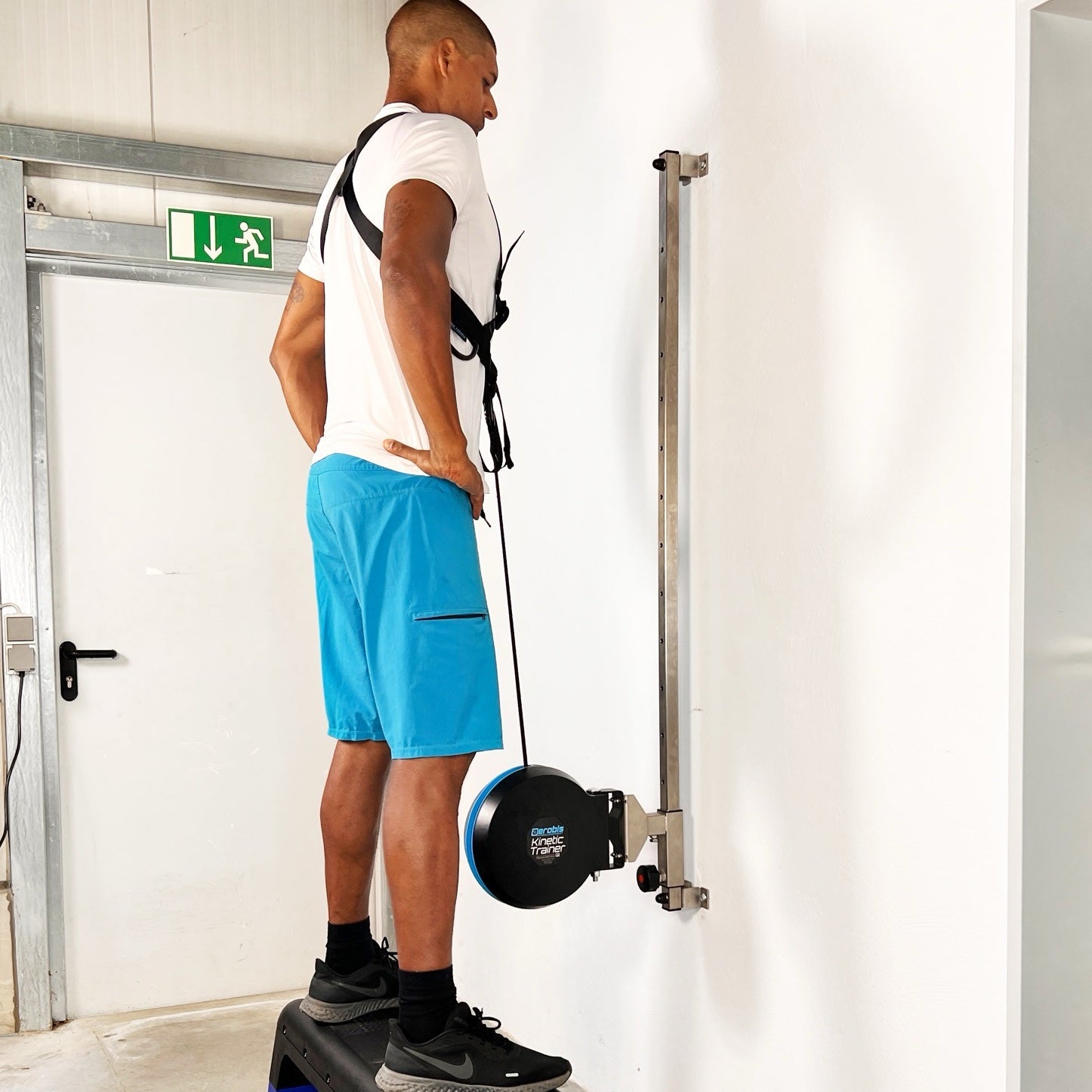
Walk into almost any home gym and you will see the same thing: dumbbells, plates, kettlebells. All of them work the same way - they fight gravity, straight down, and they give you exactly as much resistance as the number on the side says. That is fine for a lot of training. But it leaves one of the most powerful tools for building strength almost untouched: the eccentric, the lowering phase of every rep. Flywheel training is built around exactly that phase, and the science behind it is hard to ignore.
If you have never trained with a flywheel before, this guide walks you through what it is, why eccentric overload matters, what the research actually says, and how to get started.

What is flywheel training?
Instead of lifting a weight against gravity, you spin a rotating disc - the flywheel. As you pull or push during the concentric phase, you accelerate the disc and store energy in it. When you reach the end of the movement, the disc keeps spinning and winds the strap back in, pulling against you. To stop it, you have to brake the movement: that is your eccentric phase.
The clever part is that the resistance is not fixed. The harder you push in the concentric phase, the more energy goes into the flywheel, and the harder it pulls back. The device adapts to your effort on every single rep. There is no stack to adjust and no gravity to depend on, which means a flywheel works just as well for a horizontal row or a rotation as it does for a squat.
Eccentric overload: the part gravity cannot give you
Here is the key idea. Your muscles are stronger when they lengthen under load (eccentric) than when they shorten (concentric) - by roughly 30 % in many movements. With a barbell, the weight is the same up and down, so the load is always capped by what you can lift on the way up. The lowering phase is left under-challenged.
A flywheel flips this. Because you put energy in over the full concentric range and then absorb it in a shorter, sharper braking phase, you can load the eccentric portion harder than the concentric - this is called eccentric overload. You train the exact phase that builds the most strength and that is most protective for your tendons and connective tissue, and you do it without needing a rack full of heavy plates.
What the research actually says
This is not a marketing claim - eccentric and flywheel training are among the better-studied methods in strength science.
A systematic review and meta-analysis of eccentric-overload flywheel training found that short bouts of high-intensity flywheel work produced greater gains in concentric and eccentric force, muscle power and hypertrophy than many traditional approaches in healthy, well-trained people. A separate meta-analysis comparing isoinertial flywheel training with traditional resistance training reported comparable or superior improvements in maximal strength and power, and a broad umbrella review in PLOS One reached the same general conclusion across athletic and healthy populations.
The injury-prevention side is just as compelling. Eccentric-focused work like the Nordic hamstring exercise has been shown to cut hamstring injury rates dramatically - an umbrella review on the Nordic hamstring exercise highlights large reductions in lower-limb injuries alongside gains in eccentric strength and muscle architecture. The mechanism is the same one a flywheel trains: controlled, high-force lengthening.
Flywheel vs traditional weights
Free weights are not going anywhere, and they should not. But a flywheel solves problems that gravity-based equipment cannot:
- Eccentric overload on every rep, instead of a load capped by your concentric strength.
- Resistance in any direction - horizontal, diagonal and rotational, not just vertical. Great for rows, presses, and rotational core work.
- Auto-adjusting load that matches your effort, so a beginner and an advanced athlete can use the same device.
- Compact and travel-friendly: no 100 kg of plates to store or move.
For most people the smartest setup is both: keep your big barbell and kettlebell lifts, and add a flywheel for eccentric overload, power and the movement directions a barbell can never cover.
How to get started with the Kinetic Trainer
Our Kinetic Trainer is a premium flywheel trainer made for exactly this kind of work. You decide the intensity through how explosively you move - the device does the rest. At just 5 kg it travels anywhere, the 250 cm strap covers full-range movements, and the multi-anchor mounts it to a wall, pole, tree or rig. It handles a load of up to 150 kg, comes ready to train with 4 mm plates, and ships complete with a double handle and ankle strap for upper- and lower-body work.
A few tips to make your first sessions count:
- Start light and learn the brake. The skill of flywheel training is the eccentric. Accelerate smoothly in the concentric phase, then resist hard in the last third of the way back. That late, sharp brake is where the overload happens.
- Use a harness for lower-body and pulling work. The Fitness Harness connects you cleanly to the trainer for squats, rows and hip work.
- Add load when you are ready. The 8 mm plates increase the inertia for experienced users who want more resistance.
A simple 20-minute flywheel session
Once you are comfortable with the movement, try this full-body circuit. Do 3 to 4 sets of 6 to 8 hard reps per exercise, resting around 60 to 90 seconds between sets:
- Flywheel squat - drive up fast, brake the descent over the last third.
- Standing row - pull explosively, resist the return to your chest.
- Rotational pull - train the core and obliques in a direction free weights struggle with.
- Romanian-style hip hinge - one of the best eccentric exercises for the hamstrings.
Keep the reps crisp. Quality of the eccentric beats quantity every time - stop the set when you can no longer brake hard and in control.
Who flywheel training is for
Athletes use it for power and change-of-direction strength. Physios and their clients use it for tendon health and structured eccentric loading. And anyone building a serious home setup gets gym-level strength stimulus from a device that fits in a corner. If you have plateaued with the same dumbbells and want a genuinely different stimulus, this is it.
The best flywheel exercises to start with
Not sure which flywheel exercises to pick? Start with the flywheel squat, standing row, rotational pull and Romanian-style hip hinge from the session above - a handful of flywheel exercises that already train the whole body. Keep every rep crisp and let the late, sharp brake do the work.
Ready to train the phase your weights have been ignoring? Explore the full flywheel training and add eccentric overload to your training.


Leave a comment
All comments are moderated before being published.
This site is protected by hCaptcha and the hCaptcha Privacy Policy and Terms of Service apply.