

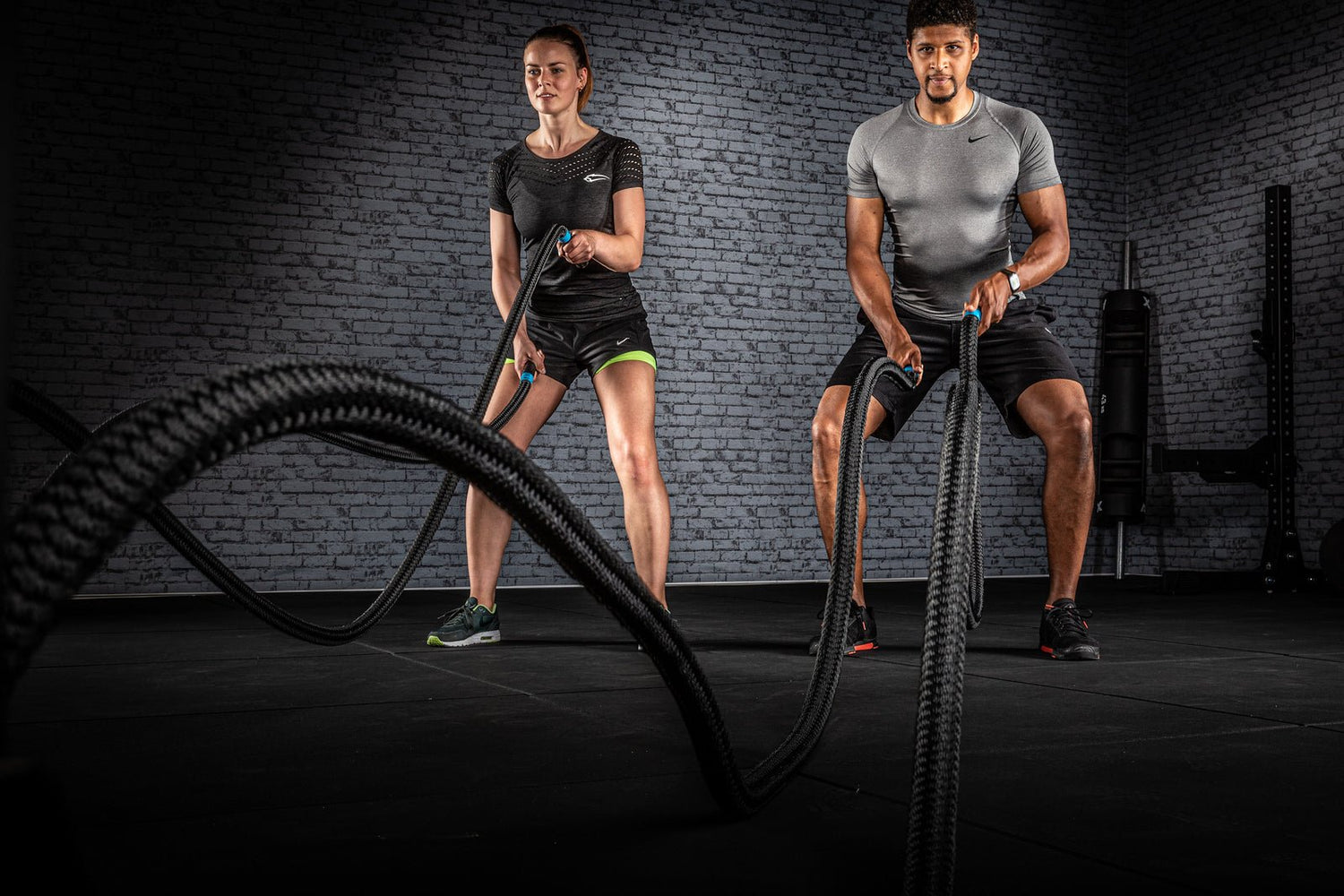
If you want a single piece of kit that hammers your strength, your cardio and your mental grit at the same time, a battle rope workout is hard to beat. The waves look chaotic, but they hide a surprisingly precise training tool: you control the intensity with every swing, you can scale it from beginner to athlete, and you barely stress your joints while doing it. In this guide you will learn what battle ropes train, why they work so well, how to set them up, and a ready-to-use session you can start today.
What a battle rope workout actually trains
People assume battle ropes are an arms-and-shoulders show. They are far more than that. Generating and sustaining waves forces your whole kinetic chain to fire: your forearms and grip keep hold of the rope, your shoulders and upper back drive the waves, and your core works overtime to stop your torso from twisting and collapsing. When you add a squat stance, lunges or slams, your glutes, quads and hamstrings join in too.
That is what makes the battle rope a true full-body conditioner. You are training power, muscular endurance and cardiovascular fitness in one movement, which is exactly why coaches reach for ropes when time is short and the goal is to get athletes breathing hard fast.

Why the battle rope workout is so effective
The science backs up what your lungs already tell you. In ACE-commissioned research at the University of Wisconsin-La Crosse, a 10-minute interval session using 15-second work bouts and 45-second rest periods pushed participants to a vigorous intensity and burned roughly 141 calories in those few minutes of actual work. The researchers noted that ropes drive heart rate disproportionately high because so much upper-body muscle mass is involved at once.
Other lab work points the same way. A study in the Journal of Strength and Conditioning Research comparing free-weight, bodyweight and battling rope protocols found ropes deliver a serious metabolic stimulus, and follow-up research showed that shorter rest intervals raise the cardiovascular demand even further. The takeaway: a battle rope workout is genuinely vigorous exercise, not a gimmick, and short dense intervals are where it shines.
Because the load comes from moving the rope rather than landing or lifting heavy external weight, the joint impact stays low. That combination of high effort and low impact is rare, and it makes ropes a smart option for people who want intensity without pounding their knees and spine.
How to use battle ropes: setup and stance
Getting started is simple. Loop your rope around a solid, immovable anchor at its midpoint so you hold both ends with equal length on each side. A wall mount, a power rack upright, a heavy kettlebell or a sturdy post all work. A short rope feels heavier and more intense because more of its mass is moving; a longer rope is easier to keep going and better for endurance.
Your stance is the foundation of every wave. Set your feet a little wider than your hips, soften your knees into a quarter-squat, brace your core and keep a tall, neutral spine. Grip the ends firmly but stay relaxed through the jaw and neck. From there, the power comes from your hips and trunk driving through your arms, not from yanking with your shoulders alone.
6 battle rope exercises to build your session
- Alternating waves: the classic. Drive one arm up while the other comes down, keeping a fast, steady rhythm. This is your bread-and-butter conditioning move.
- Double waves: raise and slam both arms together for bigger, more powerful waves. More force per rep, so expect your shoulders and core to light up quickly.
- Power slams: rise onto the balls of your feet, lift both rope ends overhead, then slam them down hard while dropping into a partial squat. A full-body power expression and a great finisher.
- Rope waves with a squat hold: sink into a squat and hold it while you keep the waves going. Your legs burn, your grip is tested and your heart rate climbs fast.
- Side-to-side waves: swing both arms left, then right, whipping the rope across your body. This hits your obliques and adds a rotational challenge.
- In-and-out waves: move both arms apart and together horizontally to work the chest, shoulders and arms from a different angle.

A simple 15-minute battle rope workout
This interval format mirrors the protocols used in the research above: short, hard efforts with enough rest to keep the quality high. Warm up for a few minutes first with easy waves and some shoulder and hip mobility.
- Round structure: 20 seconds all-out work, 40 seconds rest.
- Exercise 1: Alternating waves
- Exercise 2: Double waves
- Exercise 3: Side-to-side waves
- Exercise 4: Power slams
Run through all four exercises, then repeat the circuit three times for a total of 12 working sets. If 20 seconds feels too easy, push to 30 seconds of work; if your form falls apart, shorten the work and lengthen the rest. Beginners can start with two rounds and build up. The goal is hard, clean waves, not flailing.
Choosing the right rope for your workout
The rope you train with shapes the workout. Diameter and length are the two levers that matter most. A thicker 40 mm rope is harder to grip and move, which tilts training toward strength and power, while a 30 mm rope is friendlier for endurance work and for beginners building their base. Length is the bigger decision: a 15 m rope lets you control intensity by deciding how far you send the waves, whereas a 10 m rope suits compact spaces and feels more intense set for set.
Quality matters more than people expect, because cheap ropes fray, soak up water and lose their shape. The aerobis Premium Battle Rope is woven from robust polyester that is UV-resistant and weatherproof, so it holds up indoors and outdoors, and the polyester construction makes it up to 35 % heavier than typical hemp or nylon ropes for a stronger training stimulus. A steel compression ring keeps the grip from slipping off, and the set ships with the rope, wall mount, carabiner and fixation loops so you can anchor it straight away. You can compare every diameter and length, plus mounts and accessories, in the full Battle Ropes collection.
Common mistakes to avoid
Two habits hold most people back. The first is using only the arms: if your waves die out after 10 seconds, you are almost certainly forgetting to drive from your hips and brace your core. The second is going too long. Ropes reward short, brutal efforts, so a sloppy 60-second set teaches your body to move slowly. Keep your intervals tight, keep the rope moving fast, and stop the set when the quality drops rather than grinding out junk reps.
Bottom line
A battle rope workout gives you strength, conditioning and power training in one low-impact package that fits in a garage, a gym or a park. Anchor a good rope, nail your stance, pick a handful of waves and run them in short hard intervals. Do that two or three times a week and you will feel the difference in your grip, your shoulders, your core and your cardio fast. Grab a rope, set your timer and go all out.

Leave a comment
All comments are moderated before being published.
This site is protected by hCaptcha and the hCaptcha Privacy Policy and Terms of Service apply.