

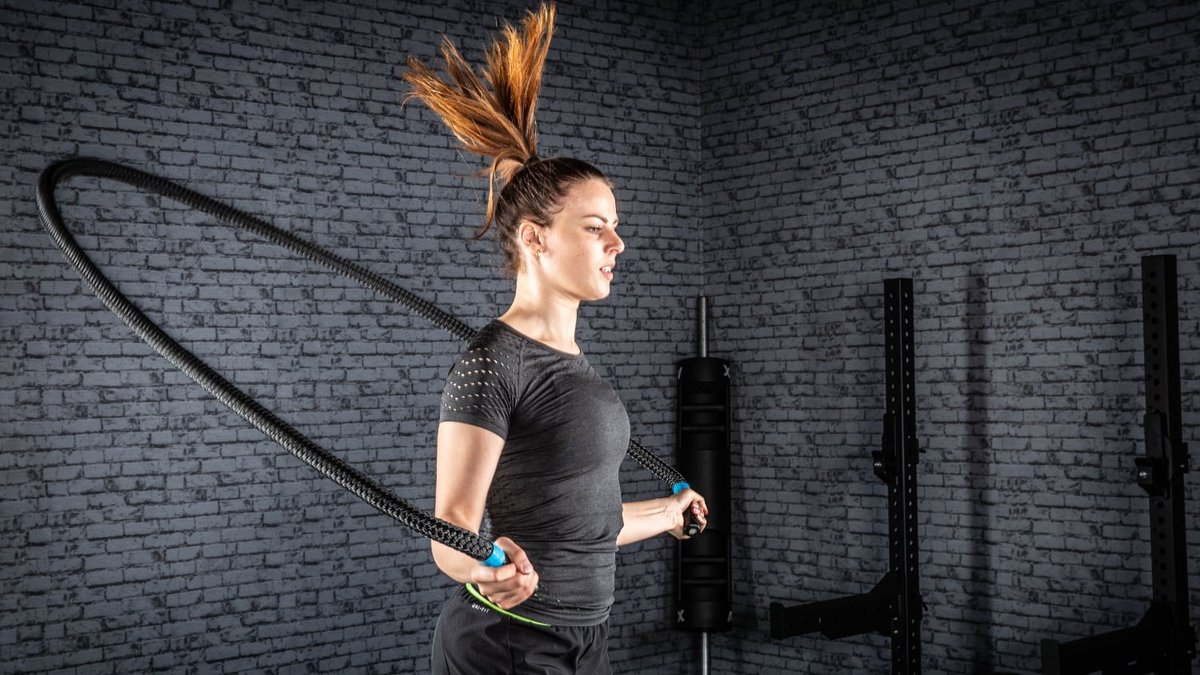
Short answer: The best weighted jump rope depends on what you want to train. For fast footwork and learning timing, pick a light speed rope. For more shoulder and arm work with a familiar rhythm, a rope of about 0.5 to 1 kg (1 to 2 lb) is a good middle ground. For full-body conditioning and grip strength, choose a heavy rope from 1.4 kg (3.1 lb) upwards, like the aerobis Battle Jump Rope with 1.4 kg (3.1 lb) Starter, 1.8 kg (4 lb) Athlete or 2.2 kg (4.9 lb) Professional. Also check the length for your height, handles that do not slip and a rope that can handle the surface you train on.
Jump ropes differ in where the weight sits, how heavy the rope is and how fast it turns. This guide compares the common types, helps you pick a weight, lists six checks before you buy and shows where the two aerobis jump ropes fit.
Jump rope types compared
| Type | Typical weight | Speed | What it trains | Best for |
|---|---|---|---|---|
| Speed rope (thin cable or textile) | Under 200 g (7 oz) | Very fast | Footwork, timing, coordination, calves | Double unders, warm-ups, learning to skip |
| Weighted handles | Light rope, extra weight in the handles | Fast | Forearms and shoulders, the rhythm stays familiar | Adding arm work to normal skipping |
| Weighted rope (thicker cable or PVC) | About 0.5 to 1 kg (1 to 2 lb) | Medium | Shoulders, arms, endurance | Steady progression from a light rope |
| Heavy rope in battle rope style | 1.4 to 2.5 kg (3.1 to 5.5 lb) | Slow | Full body, grip, core, conditioning | Short, hard intervals and strength endurance |
With a heavy rope, the weight is spread along the whole rope. You move it with your shoulders, back and core, and the turning rope keeps your grip working the entire time. Weighted handles load mainly your forearms, while the rope itself stays light.
Which weight is right for you?
Start with what you want from a session:
- Learning to skip or getting faster: a light rope. It forgives mistakes and lets you practise rhythm and footwork.
- More arm and shoulder work at a steady pace: about 0.5 to 1 kg (1 to 2 lb). You keep a familiar rhythm and still feel the extra load.
- Conditioning, grip strength and full-body work: from 1.4 kg (3.1 lb). 1.8 kg suits you once you skip with confidence, 2.2 kg is for experienced athletes who want the highest demand.
Heavy ropes are made for intervals. Start with 20 to 30 seconds of skipping and an equal or longer rest, and add time once your technique holds. You can also combine both: a light rope for warm-ups and footwork, a heavy rope for the hard part. Read more about the effect in our article on the benefits of heavy jump rope training.
Finding the right length
Stand on the middle of the rope with one foot. With a light rope, the handles should reach roughly to your armpits. A heavy rope turns in a wider arc, so its length and your height decide the fit: the aerobis Battle Jump Rope is 3 m (9.8 ft) long and suits athletes from about 1.65 to 1.95 m (5 ft 5 in to 6 ft 5 in) tall. A textile rope like the aerobis Jump Rope made from aeroSling rope can be shortened with extra knots.
6 checks before you buy
- Weight: Match it to your goal: light for speed, medium for steady progression, heavy for conditioning and grip.
- Length: Check the length against your height or choose a rope you can shorten.
- Rope diameter: A thick rope trains your grip with every turn. A thin rope turns faster and suits speed work.
- Handles: Non-slip handles that stay firmly fixed to the rope keep your hands relaxed during long intervals.
- Material and surface: For outdoor training, choose a weatherproof, abrasion-resistant rope. Textile ropes are gentle when they hit your shins.
- Space: A heavy rope needs room above and around you. Check your ceiling height and keep away from furniture before your first set.
Where the aerobis jump ropes fit
- Battle Jump Rope: Heavy rope in battle rope style, 3 m (9.8 ft) long, in three weights: 1.4 kg (3.1 lb) Starter, 1.8 kg (4 lb) Athlete and 2.2 kg (4.9 lb) Professional. Non-slip handles, weatherproof and UV-resistant for indoors and outdoors. For full-body conditioning, grip strength and short, intense intervals.
- Jump Rope made from aeroSling rope: Light, fast textile rope made from 6 mm polyamide aeroSling rope. 300 cm (9.8 ft) long, about 270 cm (8.9 ft) with the handle knots, shorter with extra knots, packs small. For speed, footwork and warm-ups.
If you want to move a heavy rope without jumping, compare classic battle ropes in our battle rope buying guide.
FAQ
Is a weighted jump rope better than a normal one?
It trains something different. A weighted rope puts more load on your shoulders, arms and grip and raises the demand per minute. A light rope is better for speed, timing and double unders.
How heavy should a weighted jump rope be?
About 0.5 to 1 kg (1 to 2 lb) for steady progression from a light rope, from 1.4 kg (3.1 lb) for conditioning and grip strength. Heavy ropes of 1.8 to 2.2 kg (4 to 4.9 lb) are for you once you skip with confidence.
Can beginners use a heavy jump rope?
Yes, with short intervals. Learn the basic rhythm with a light rope first, then start with 20 to 30 seconds on the heavy rope and rest in between.
Can you do double unders with a heavy rope?
Only very rarely. A rope of around 2 kg (4.4 lb) is made for power and endurance. For double unders, use a light speed rope.
Is a heavy jump rope good for losing weight?
A heavy rope works many muscles at once and raises your heart rate fast, so a short session is very demanding. Whether you lose weight also depends on your diet and how active you are during the day.
Can I use a heavy jump rope outdoors?
Yes, if the rope is weatherproof and abrasion-resistant. The aerobis Battle Jump Rope is made for indoor and outdoor use. Train on an even surface.

Leave a comment
All comments are moderated before being published.
This site is protected by hCaptcha and the hCaptcha Privacy Policy and Terms of Service apply.