

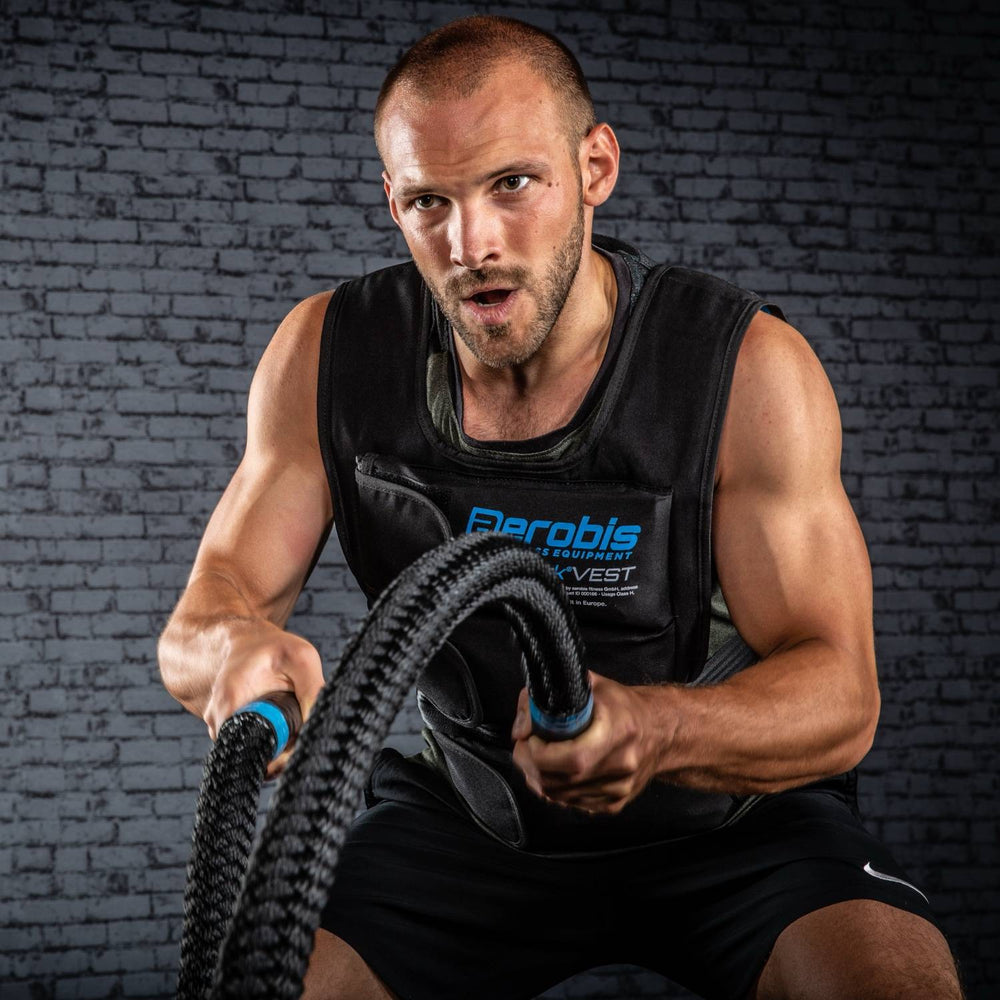
Short answer: For a home gym or a studio, the best battle rope is a 30 mm (about 1.2 in) polyester rope in 10 m (33 ft) length, fixed to a solid wall anchor. Choose 40 mm (about 1.6 in) if you already train with heavy ropes and want more strength work. Choose 15 m (49 ft) if you have the floor space, because a longer rope lets you run longer waves and control the intensity better. Polyester ropes keep their shape, do not soak up water and can be used outdoors.
Battle ropes differ in thickness, length, weight, material, grip ends and anchoring. This guide compares the common sizes and materials, lists six checks before you buy and shows where the aerobis ropes fit.
Battle rope sizes compared
| Thickness | Length | Weight (aerobis polyester rope) | Free floor needed | Best for |
|---|---|---|---|---|
| 30 mm (1.2 in) | 10 m (33 ft) | 5.5 kg (12.1 lb) | about 6 m (20 ft) | Beginners, home gyms, HIIT finishers |
| 30 mm (1.2 in) | 15 m (49 ft) | 8 kg (17.6 lb) | about 9 m (30 ft) | Longer intervals, studios, outdoor training |
| 40 mm (1.6 in) | 10 m (33 ft) | 7.7 kg (17 lb) | about 6 m (20 ft) | Advanced athletes with limited space |
| 40 mm (1.6 in) | 15 m (49 ft) | 12 kg (26.5 lb) | about 9 m (30 ft) | Advanced athletes, team training, strength endurance |
The rope is folded around the anchor, so you stand about half the rope length away from it. Leave some extra room behind you for lunges and side steps.
Battle rope materials compared
| Material | Feel and weight | Outdoor use | Care |
|---|---|---|---|
| Polyester | Heavy for its diameter, even waves | UV-resistant, does not absorb water | Low |
| Nylon | Lighter, slightly stretchy, softer waves | Possible, takes on some water | Low |
| Manila or hemp | Rough grip, sheds fibres | Absorbs water, can rot if stored wet | High |
How to choose: six checks before you buy
- Your space. The length follows your space. Measure from the anchor point to where you will stand and add room behind you. A 10 m rope needs about 6 m of free floor, a 15 m rope about 9 m. If the space is there, go longer: on a long rope you set the intensity by how far the waves travel.
- Thickness. 30 mm suits beginners, smaller hands and fast intervals. 40 mm is harder to hold and moves more mass with every wave, which suits advanced athletes and strength endurance. If you are unsure, pick the longer rope before the thicker one.
- Weight. Weight depends on diameter, length and material. A heavier rope is only better if you can still make clean waves for 20 to 40 seconds.
- Material. Polyester keeps its shape, does not stretch when wet and copes with sun and rain. Natural fibre ropes shed fibres and need dry storage.
- Grip ends. Check how the ends are finished. Loose shrink tubing or tape can slide off during hard sets. The aerobis Battle Rope has a steel compression ring under each grip, and the rope ends are sewn to the core.
- Anchor and protection. Indoors, a wall anchor at floor height gives you a fixed point. Outdoors, loop the rope around a post or a tree and protect it with a sleeve where it rubs. Loose weights on the floor are no reliable anchor, because the rope drags them along.
Which battle rope fits which goal?
- Starting at home: 30 mm and 10 m. Enough for waves, slams and circles in a garage, a basement or a living room.
- Studios and team training: 30 mm and 15 m for long intervals with several athletes taking turns.
- Strength endurance for experienced athletes: 40 mm in 10 or 15 m.
- Very little floor space: the Battle Jump Rope gives you the same heavy rope as a 3 m skipping rope, with 1.8 kg in 30 mm or 2.2 kg in 40 mm.
aerobis battle ropes at a glance
- Battle Rope: polyester rope in 30 or 40 mm and 10 or 15 m, up to 35 % heavier than conventional hemp or nylon ropes, UV-resistant and does not absorb water. Wall mount, carabiner and fixation loops are included.
- Battle Rope Protection: 50 cm sleeve made in Germany from fire hose material, for ropes from 30 to 40 mm. Slide it over the rope where it wraps around a post or a tree.
- Battle Jump Rope: 3 m heavy skipping rope made from battle rope, for endurance, grip strength and coordination.
Got your rope? Start with these battle rope exercises for beginners and then build a full session with our battle rope workout guide.
FAQ
What size battle rope should a beginner buy?
30 mm and 10 m. The rope is thin enough for a secure grip, long enough for clean waves and fits into a home gym.
How long should a battle rope be?
As long as your space allows. A 10 m (33 ft) rope needs about 6 m of free floor, a 15 m (49 ft) rope about 9 m. A longer rope gives you more control over the intensity.
How heavy is a battle rope?
That depends on diameter, length and material. The aerobis polyester ropes weigh from 5.5 kg (30 mm, 10 m) to 12 kg (40 mm, 15 m).
30 mm or 40 mm?
30 mm for beginners, fast intervals and smaller hands. 40 mm for advanced athletes who want more grip and strength work. If in doubt, choose more length over more thickness.
How do I anchor a battle rope?
Indoors with a wall anchor fixed in solid masonry or concrete at floor height. Outdoors around a post or a tree, with a protective sleeve. Check the anchor before every session.
Can I use a battle rope outdoors?
Yes, if the rope is weatherproof. Polyester ropes do not absorb water and are UV-resistant. Let the rope dry before you store it and keep it away from sharp edges.

Leave a comment
All comments are moderated before being published.
This site is protected by hCaptcha and the hCaptcha Privacy Policy and Terms of Service apply.