

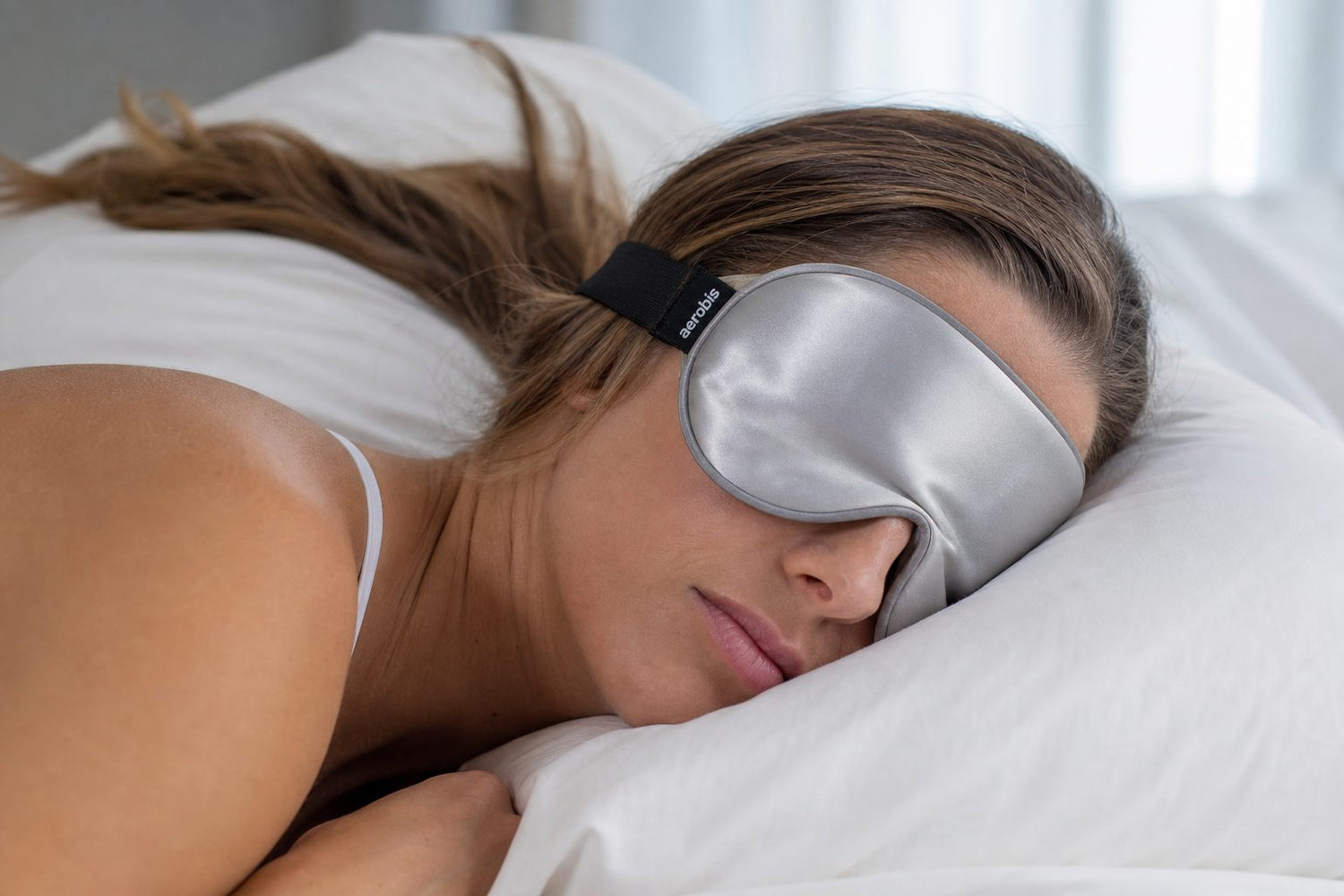
You can chase the perfect session. If the night after it is bright, broken or short, you leave most of the adaptation on the table. Muscle repair, glycogen refill and the hormone work that follows hard training all lean on deep, dark sleep. A sleep mask will not fix a 5 h night. It will take stray light out of the equation so your brain can actually switch off. That is the job of a blackout sleep mask for athletes: protect the recovery window you already earned.
Why blackout recovery matters
Light is the strongest cue your body clock has. Even a thin strip of streetlight or an LED alarm clock can delay melatonin and keep sleep lighter than it looks on your watch. After a late session you are already running hot. Heart rate is slower to settle. Core temperature is still up. Add a bright bedroom and you spend the first 90 min of the night half awake.
Blackout is not a wellness slogan. It is a simple rule: if your room cannot go fully dark, cover the eyes. Hotels, summer mornings at 04:30, shared flats and night buses will never give you a cave. A mask will.
When a sleep mask actually helps
Tick what is true this week. Two or more boxes means a mask is worth using tonight, not "someday".
When a mask helps
Skip the mask only if your room is already pitch dark and you fall asleep in minutes. If you wear one and still wake at 03:00, look at caffeine after 15:00, a late large meal or a bedroom that is too warm. The mask is a light tool, not a full sleep protocol.
How much sleep after a hard day?
Most trained adults do better in a 7.5 to 9 h in-bed window when the day included heavy lifting, intervals or two sessions. Skill or easy days can live closer to 7 to 8 h. The point is not a magic number. It is getting to bed early enough that the last alarm is not the first thing that cuts REM.
How to use a sleep mask (so it does not become another gadget)
- Lights out means mask on. Do not scroll under it.
- Put it on in bed, after the last look at a bright screen.
- Side sleepers need a contoured cup so the foam does not press the eyeball.
- On travel days, use it for the flight nap and the hotel night. That is when clocks and curtains fail you.
- Wash it. A sweaty mask after a late session is why people quit in week two.
What matters on the mask (and what does not)
You are buying darkness and comfort, not a spec sheet. True blackout around the nose. No pressure on the eyes, so you can blink. A strap that stays put when you roll. Light enough for a bag. That is the list.
If you want one built for that job, the aerobis sleep mask is a 100 % blackout, contoured option we use for late sessions, travel and bright rooms. This post is about the habit. The product page has the details.
A simple recovery night
- Last caffeine 8 h before bed.
- Dim the main lights in the last 30 min.
- Same bedtime on training days and rest days, plus or minus 30 min.
- Mask on, phone outside reach.

FAQ
Can a sleep mask replace blackout curtains?
No. Curtains help the whole room. A mask helps when curtains are thin, when you travel, or when you share a room. Use both if you can. Use the mask when you cannot.
Is it safe to wear one every night?
Yes, if it sits off the eyes and you keep it clean. If you wake with marks or dry eyes, loosen the strap or switch to a deeper contour.
Will it help if I only sleep 5 h?
It can make those 5 h darker and a bit deeper. It cannot invent the missing hours. Move bedtime first, then add the mask.

Leave a comment
All comments are moderated before being published.
This site is protected by hCaptcha and the hCaptcha Privacy Policy and Terms of Service apply.