

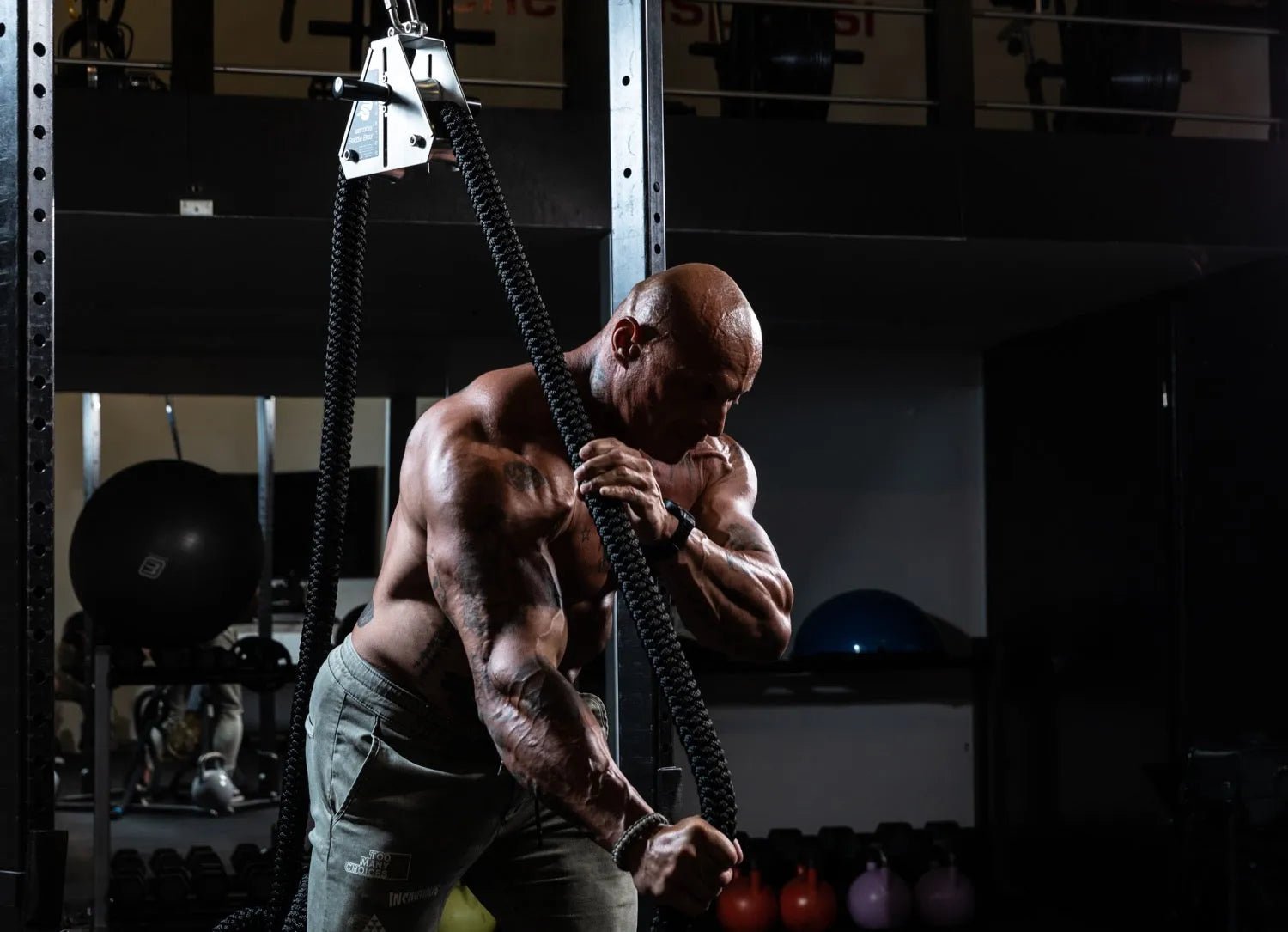
Scroll through any fitness feed and you will find physiques presented as the product of nothing but discipline. Some of them are. Many are not. The gap between what is achievable naturally and what is being sold as achievable naturally is the reason this question keeps coming up: how much muscle can a person actually build without drugs?
The honest answer is that nobody can calculate your personal ceiling. What the research can tell you is where you stand today and what a realistic year looks like - and that turns out to be the more useful question anyway.
Why the question is so hard to answer
Competitions do test for performance-enhancing drugs, but a negative test is not proof of abstinence. Anabolic steroids leave lasting advantages: muscle gained during a cycle is partly retained for years afterwards, long after the substance itself has cleared. Lance Armstrong never returned a positive test during his career and later admitted to years of doping. Testing tells you less than people assume.
That leaves researchers trying to infer a natural limit from measurements of people who say they are drug-free. It is a genuinely difficult problem, and the three models you will see quoted online all handle it badly.
The three popular models, honestly assessed
The FFMI ceiling of 25
This is the most widely repeated claim: that a fat-free mass index above 25 indicates drug use. It traces back to a single study from 1995 in which 74 non-users and 83 steroid users were measured with skinfold calipers.
Three things about that study rarely get mentioned. The unadjusted values of the non-users reached at least 25.4 - the neat cut-off only appears after a height correction that the authors devised after seeing their data. The authors wrote plainly that their sample might not have been large enough to show the true upper limit of natural muscularity. And they stated explicitly that steroid use cannot be diagnosed from FFMI; they proposed it only as a reason to run an actual drug test.
Later datasets settle it. Among American college football players measured by DXA and impedance, between 21 % and 26 % exceeded an FFMI of 25. The height correction has never been reproduced either - in one of those datasets it ran in the opposite direction.
The 1 % per month rule
The idea that a beginner gains 1 to 1.5 % of body weight in muscle per month comes from a paid newsletter. It was never published in a peer-reviewed journal and has never been tested prospectively.
Applied literally it predicts 12 to 18 kg of muscle in year one for a 100 kg person. Pooling 111 studies and 1927 men, whole-body strength training adds roughly 1.5 kg of muscle over eight to sixteen weeks. Even a generous extrapolation lands at a third to a half of what the rule promises. The rule also scales off total body weight including fat, which means it credits fat mass with building muscle.
There is a second problem: the two models contradict each other. Someone following the 1 % rule for a single year would sail straight past the FFMI limit that the same articles present as a hard biological wall.
Frame size from wrist and ankle girth
This model predicts your maximum from skeletal measurements, using a regression fitted to a curated collection of champion bodybuilders. It has never been peer-reviewed, the underlying dataset is not public, and it therefore cannot be checked or disproved by anyone else.
A regression fitted to champions describes champions. It does not establish a physiological limit. And the most recent work on the question finds that pre-training bone characteristics barely predict lean-mass gains at all.
Work out your FFMI
None of this makes the FFMI useless. As a description of how much lean tissue you carry relative to your frame, it tells you something body weight alone cannot. Just treat it as a position on a distribution, not as a verdict.
For context, the median FFMI of men aged 18 to 34 in the general population is about 18.9, and about 15.4 for women. Anything in the low twenties for a man means genuinely well-trained. And remember that fat-free mass is not muscle - it includes water, glycogen, bone and organs, which is exactly why the first few weeks of training look so dramatic on the scale.
What the data actually supports
Strip away the formulas and a few things are reasonably well established.
- Roughly 4 to 7 kg of lean mass in a well-executed first year for a genuinely untrained young man. Exceptional responders reach nine or ten.
- The rate roughly halves in each following year. Most of a lifetime's natural muscle gain happens in the first two to three years of correct training.
- Women build muscle just as well. Pooling 29 studies, relative growth is essentially identical between the sexes. Women gain fewer absolute kilograms because they start from less muscle, not because their muscle responds less. The old advice to halve every number for women is simply wrong.
- People differ enormously. In the largest study of its kind, 585 people ran the same twelve-week programme and the change in muscle cross-section ranged from minus 2 % to plus 59 %. Training volume did not explain the difference.
That last figure sounds discouraging until you look closer. Most people clustered in the middle, genuine non-responders were well under 1 %, and a good part of the apparent spread is measurement noise rather than a fixed personal trait. When the same people repeat an intervention, the differences shrink considerably - and someone who responds poorly to one dose often responds well to another.
For perspective
American college football players are selected for size, professionally coached and fed for four years. Across their entire college career they gain around 4 kg of lean mass. That is what a fully optimised environment produces once the beginner window has closed.
If a physique on your screen looks like it skipped that arithmetic, it probably did.
What to do instead of calculating your ceiling
No formula, no wrist measurement and no commercial DNA test can tell you where you will finish. What is knowable is your current position and your trajectory, and those are the only two things you can act on:
- Progressive overload - the same exercises, done measurably better over time
- Ten to twenty hard sets per muscle group per week
- Around 1.6 g of protein per kg of body weight per day
- Seven hours of sleep or more, on a consistent schedule
- Years rather than weeks
That list is unglamorous, which is precisely why it does not sell supplements. It is also the whole of it.
We go into all of this in far more depth - including the training dose, the nutrition and the recovery side - in the aerobis Fitness Guide 2.0, free to read and fully referenced. And if you want the equipment to do the work with: have a look around the shop.
Sources
Kouri EM et al. (1995), Clin J Sport Med 5(4):223-228 · Trexler ET et al. (2017), J Strength Cond Res 31(10):2719-2727 · Fields JB et al. (2024), Int J Exerc Sci 17(4):129-139 · Schutz Y et al. (2002), Int J Obes 26(7):953-960 · Benito PJ et al. (2020), Int J Environ Res Public Health 17(4):1285 · Trexler ET et al. (2017), J Strength Cond Res 31(1):1-8 · Refalo MC et al. (2025), PeerJ 13:e19042 · Hubal MJ et al. (2005), Med Sci Sports Exerc 37(6):964-972

1 comment
Javier
💪
Leave a comment
All comments are moderated before being published.
This site is protected by hCaptcha and the hCaptcha Privacy Policy and Terms of Service apply.