

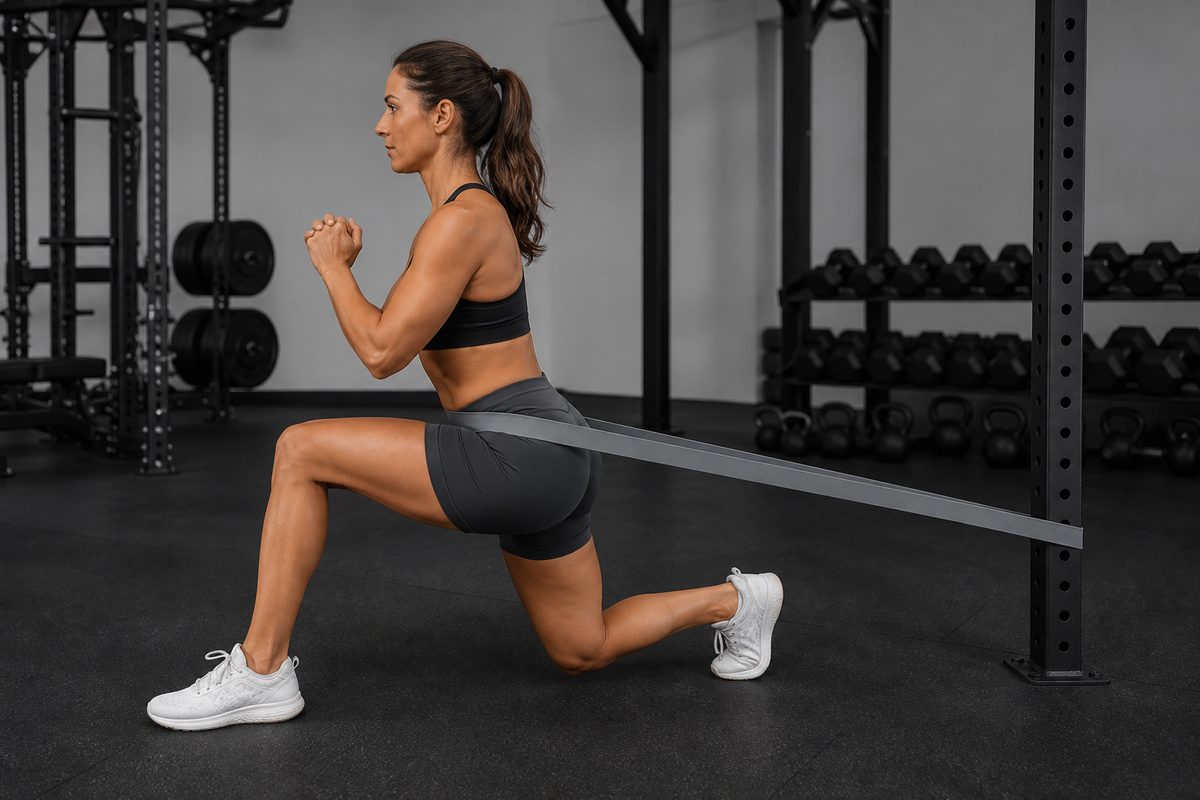
A lunge is already a strong single-leg pattern. Add a powerband and the same step asks more of your quads, glutes and the small muscles that keep the knee tracking. Resistance band lunges, also called banded lunges or lunges with a resistance band, load reverse, walking and forward lunges without a barbell rack. One loop, a low solid anchor and a few metres of floor are enough, at home, in the gym or on a stone pier.
This guide stays on the forward-and-back lunge with a long powerband. It is not a sideways hip walk and not a multi-move backside list. You will set the band up, lock in cues, clean up mistakes, then progress reverse, walking and forward lunges so legs and glutes get stronger.
What resistance band lunges train
A banded lunge is a split-stance squat that travels. The front leg takes most of the load through the quad and glute. The rear hip flexor opens. Deep hip rotators keep the front knee from collapsing inward. Band tension rises as the loop stretches, so the stand-up is usually hardest, right where your glute is strongest. That is a different job from a lateral walk and from a squat where both feet stay planted. A 100 cm powerband lets you change load by moving closer to or farther from the anchor. Start light or medium. Move up only when every rep looks the same on both sides.
Setup: band, anchor, stance

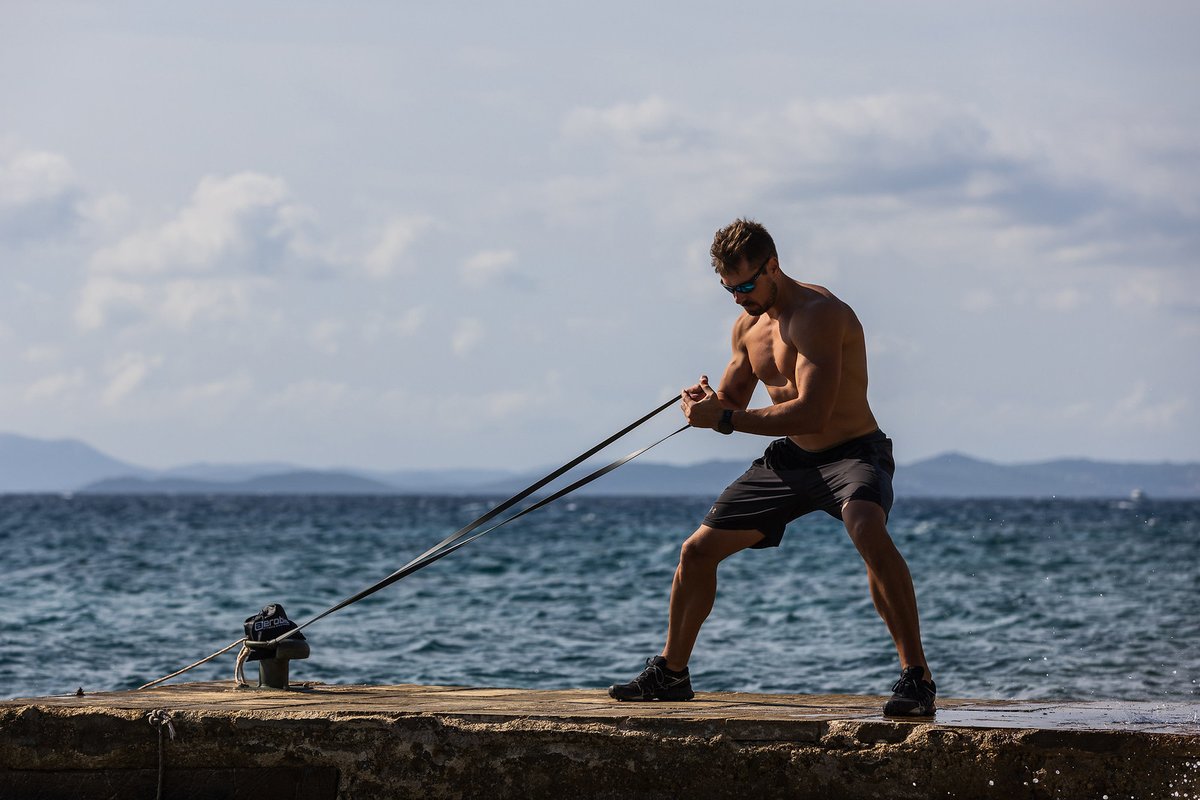
You need one powerband and something solid and low to loop it around. The photo uses a weathered mooring bollard on a seaside pier. At home that is a rack upright, a heavy post or a sturdy railing. Check the loop cannot slide up or slip off.
- Low rear anchor. Loop the band around the bollard or post, step inside it or hold the free end, and face away. The band pulls you back. Fight that pull as you stand. Use this for reverse lunges and for the forward lunge with a diagonal press.
- Stand in the loop. Both feet on the band, hip-width, other side at your shoulders. Reverse lunges stay in place and the band loads the front leg as you stand.
- Front-loaded carry. Hold the loop at your chest and walk when you have no anchor.
Take the slack out before the first working set. You should already feel light tension. If the band goes floppy at the bottom, step farther from the anchor or choose a stronger band.
The Premium Powerbands are latex-free silicone loops, each 100 cm long and 4 mm thick, in four strengths: Light around 10 kg, Medium around 20 kg, Heavy around 30 kg and Very Heavy around 40 kg. Each band stretches up to 300 %, so you fine-tune load with distance from the anchor.
How to do reverse, walking and forward lunges
Reverse lunges are the most stable. Walking lunges add travel. Forward lunges with a low rear anchor and a press ask the most of your balance.
Reverse lunges with a powerband

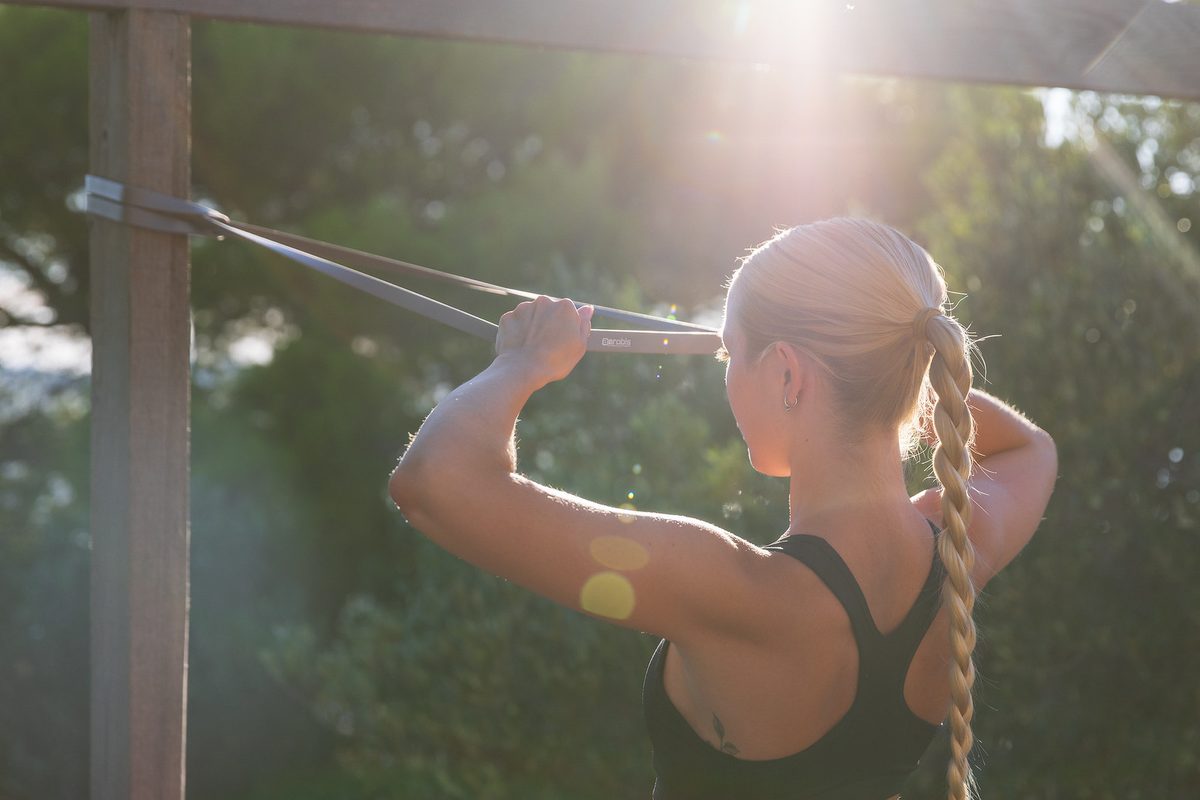
Face away from a low anchor with the band around your hips or at your shoulders, or stand on the band and hold the top at shoulder height.
- Stand tall, feet about hip-width, light tension already on the band.
- Step one foot straight back. Land on the ball of the rear foot, heel up.
- Lower until both knees are close to 90 degrees. Front shin fairly vertical. Rear knee toward the floor without crashing.
- Drive through the front heel and mid-foot to stand. Return the rear foot.
- Finish the set on one side, then switch, or alternate if your balance is solid.
The band should make the stand-up harder, not yank you off the line. If you feel pulled into a backbend, the anchor is too high or you are leaning on the band.
Walking lunges

Hold the band at your chest or across your upper back. Step forward, drop into the lunge, then bring the rear foot through. Keep the steps the same length. From a low rear anchor, walk four to six steps and start again. The last hard step only counts if you still own the knee line.
Forward lunge with a diagonal press

This is the move in the photo: a forward lunge on a stone pier, a black powerband looped around a low bollard, the free end pressed forward and up on a diagonal.
- Loop the band low around the bollard or post. Hold the free end in one hand, or pass it across your back and press with the opposite arm.
- Face away from the anchor. Step forward into a long, stable lunge. Front foot flat, rear heel up.
- Press the band forward and slightly up, arm long, without shrugging or twisting the ribs away from the front thigh.
- Hold a clean bottom for a breath, then drive back to the start. Stay long through the torso and finish the hip.
The press is not the main lift. Drop it if the torso twists or the front knee dives in, and own the lunge first.
Cues that keep the pattern honest
- Front knee tracks over the second toe, not inside the big toe.
- Front heel stays down. If it lifts, your step is too long or you are sitting on the rear hip.
- Ribs stacked over the pelvis. A slight forward lean is fine. A soft, rounded lower back is not.
- Rear toes point roughly forward. A turned-out rear foot usually means the hip is dumping in.
- Push the floor away. Do not pull yourself up with the band. If one hip drops, shorten the step.
Breathe out as you stand. Keep a little air in the trunk so the band cannot fold you at mid-range.
Common mistakes
- No tension at the start. Step out until the band is already working.
- Knee cave on the front leg. Push the front knee slightly out as you stand. If you cannot, the band is too strong.
- Short, stuttering steps. Aim for that 90 degree picture without the front knee shooting past the toes.
- Overstriding. Shorten up until both knees can bend.
- Letting the band win the lower. Take 2 to 3 seconds down.
- Shrugging through the diagonal press. Shoulder down, arm long, ribs over the front thigh.
- Changing the step every rep. Pick a floor mark and return to it.
If your rear knee hurts, stay taller and stop a few centimetres above the floor. If the front knee hurts, sit more into the hip and check it is not diving inward.
Progressions
Stay with one variation until both sides look clean. Then change one thing at a time: bodyweight reverse lunge, light-band reverse lunge, a 1 to 2 second pause at the bottom, walking lunges with the band at the chest, forward lunge from a low rear anchor, then the same lunge with the diagonal press as in the pier photo. After that, a stronger band or more distance from the anchor, then a 3 second lower. Film one set from the front. If the front knee wobbles, you went up too soon.
How to program banded lunges
Use reverse lunges as the main strength piece, two or three days a week. Three to four sets of 8 to 12 reps per side, 60 to 90 seconds between sets. Put them after your warm-up. Walking lunges fit as a finisher: two sets of 10 to 16 steps, band at the chest. The forward lunge with a diagonal press is quality work: two to three sets of 6 to 8 reps per side. Progress by adding reps, then a pause, then more distance, then a stronger band. Leave at least one easier day between hard lunge sessions. If you only have 15 min, do reverse lunges and one set of the pier-style press.
The bottom line
Resistance band lunges give you a complete single-leg session from a loop you can carry in one hand. Reverse lunges build the pattern. Walking lunges add travel. A forward lunge off a low bollard, with a diagonal press, turns the same step into outdoor strength work. Set the band tight, keep the front knee honest, and progress one variable at a time. Your legs and glutes do not need a rack. They need tension you can control.

Leave a comment
All comments are moderated before being published.
This site is protected by hCaptcha and the hCaptcha Privacy Policy and Terms of Service apply.