

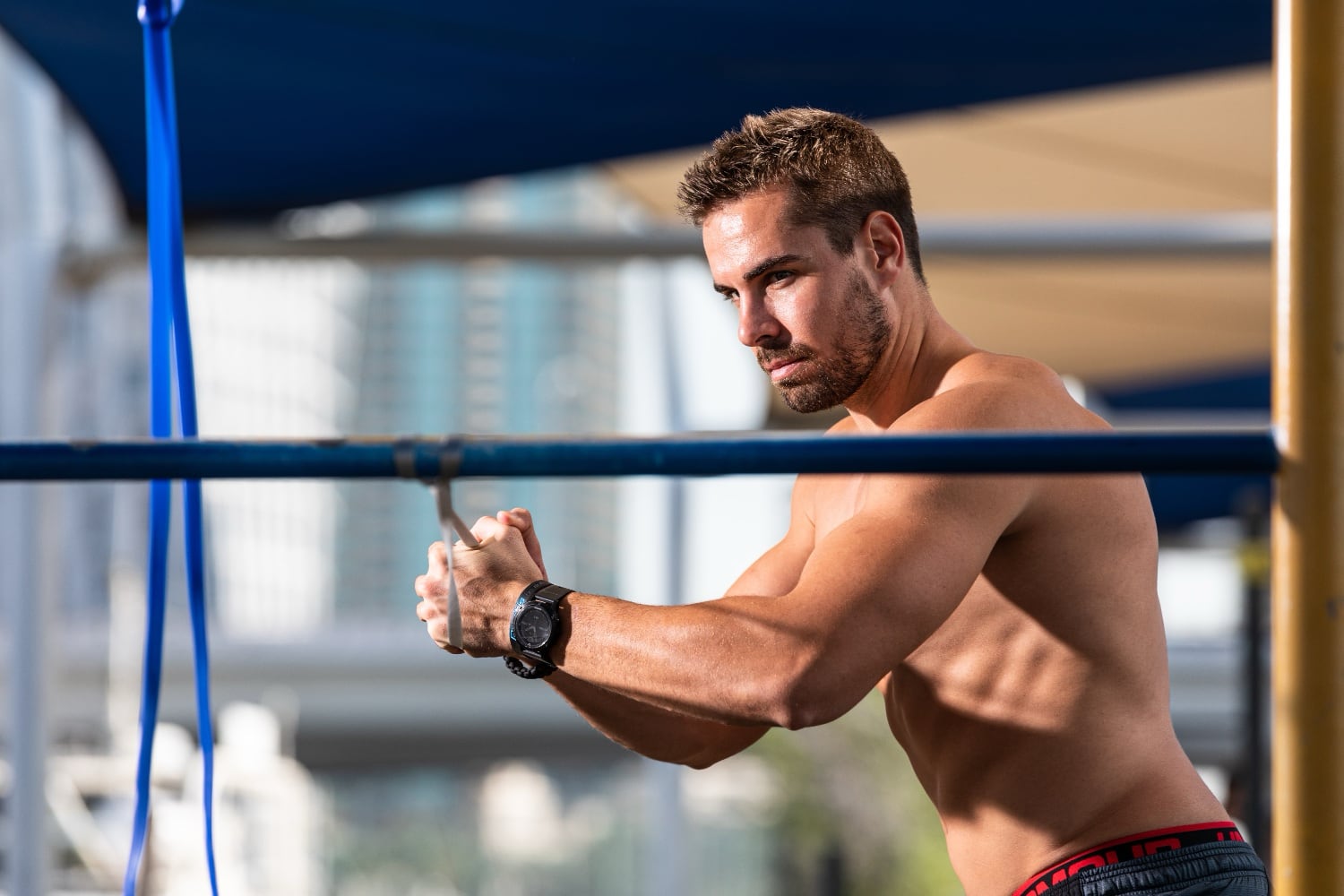
Most core training is about creating movement: crunches flex your spine, twists rotate it. The pallof press exercise works the other way around. You hold a resistance band at your chest, press it straight out, and your entire midsection has to fight to keep your torso from twisting toward the anchor. That simple idea - resisting rotation instead of producing it - is why physiotherapists, strength coaches and athletes all keep this drill in their programs. In this guide you will learn how the pallof press works, which muscles it trains, how to set it up with a band in under a minute, and the best variations to keep progressing.
What is the pallof press?
The pallof press is an anti-rotation core exercise named after Boston-based physical therapist John Pallof, who popularized it in the mid-2000s. The setup is simple: you anchor a band (or cable) at chest height, stand perpendicular to the anchor, hold the band with both hands against your sternum and press it straight out until your arms are extended. The moment your hands leave your chest, the leverage of the band trying to pull you sideways increases sharply - and your obliques, deep abdominal muscles and glutes have to work isometrically to keep your hips and shoulders square.
From the outside it looks like almost nothing is happening. That is the point. Your core is doing exactly what it is built to do in sport and daily life: transmitting force while preventing unwanted movement of your spine.
Why the pallof press exercise beats another set of crunches
Your trunk muscles are not primarily movers - they are stabilizers. Every sprint, throw, punch and heavy carry forces your midsection to control rotation rather than create it. Training that quality directly pays off in several ways:
- Better bracing for your big lifts. Squats, deadlifts and overhead presses all reward a rigid, well-braced trunk. The pallof press teaches you to build that stiffness on command, as the coaches at BarBend point out in their exercise breakdown.
- Science-backed efficiency. A randomized controlled study published in the European Journal of Applied Physiology compared anti-movement core training (isometric drills like the pallof press) with traditional dynamic core training. The anti-movement group showed greater improvements in oblique activation and neuromuscular efficiency after eight weeks.
- A back-friendly core workout. Because your spine never flexes or twists under load, the pallof press puts very little stress on your lumbar discs. The physical therapists at The Prehab Guys use it to build what they call core stiffness - a quality that supports both athletic performance and rehab in some cases of back pain.
- Carryover to rotation sports. Golf, tennis, martial arts and team sports all demand that you accelerate rotation - and stop it. Anti-rotation strength is the braking system.
Muscles worked
The pallof press looks like an arm exercise but it is a full-trunk drill. The main muscles working to resist the pull of the band are:
- Obliques (internal and external) - the primary anti-rotators.
- Transverse abdominis - your deep corset muscle that stiffens the whole midsection.
- Rectus abdominis - contracts isometrically to stabilize your spine.
- Multifidus and erector spinae - small and large back muscles that keep every segment of your spine in line.
- Glutes and scapular stabilizers - your foundation at the bottom and your posture control at the top.

How to do the pallof press with a resistance band, step by step
All you need is one band and a solid anchor: a pull-up bar, a rack upright, a fence post or a tree.
- Anchor the band at chest height. Loop it around the anchor and pull one end through the other (a girth hitch), then give it a firm tug to check it holds.
- Stand perpendicular to the anchor. Take the free end in both hands, interlace your fingers and hold it against your sternum. Step sideways away from the anchor until the band is under clear tension.
- Set your stance. Feet shoulder-width apart, knees slightly bent, glutes tight, ribs pulled down, shoulders back.
- Press straight out. Extend your arms until your elbows are locked, directly in front of your sternum. The band will try to drag your hands toward the anchor - do not let it.
- Hold for 2 to 3 seconds. Keep breathing. Your hips and shoulders stay square to the front the whole time.
- Return under control. Bring your hands back to your chest and repeat. Finish the set, then turn around and train the other side.
Quality beats quantity here. If your torso twists, your shoulders shrug or your hands drift sideways, step closer to the anchor or switch to a lighter band.
Common mistakes to avoid
- Letting the hands drift toward the anchor. Press in a dead-straight line from your sternum. Drifting takes the tension off your obliques and defeats the purpose.
- Using too much resistance. The pallof press is a precision drill, not a max-out exercise. If you have to lean away from the anchor to survive the set, the band is too strong.
- Holding your breath. Brace your core and keep breathing in short, controlled breaths. Anti-rotation strength you can only produce while holding your breath is of limited use in sport.
- Rushing the reps. The magic happens during the pause at full extension. Give every rep its 2 to 3 seconds.
- Standing too close. No tension, no training effect. Step out until you clearly feel the sideways pull before your first rep.
Pallof press variations for every level
Once the standing version feels controlled, use these variations to keep the stimulus fresh:
- Tall kneeling pallof press. Both knees on the ground, hips extended. Taking your legs out of the equation makes your trunk do all the stabilizing - a great starting point for beginners.
- Half kneeling pallof press. Inside knee down, outside foot planted. The narrow base adds a hip stability challenge on top of the anti-rotation work.
- Split stance pallof press. A lunge-like stance that mimics the leg positions of running and throwing.
- Step-out pallof press. Press the band out, then side-step away from the anchor and back while keeping your arms extended. Adds dynamic loading to the hold.
- Pallof press with overhead reach. After pressing out, raise your extended arms overhead. This extends the lever and challenges your ability to keep your ribs down.
- Pallof iso hold. Press out once and simply hold for 20 to 30 seconds per side. Brutal in its simplicity.
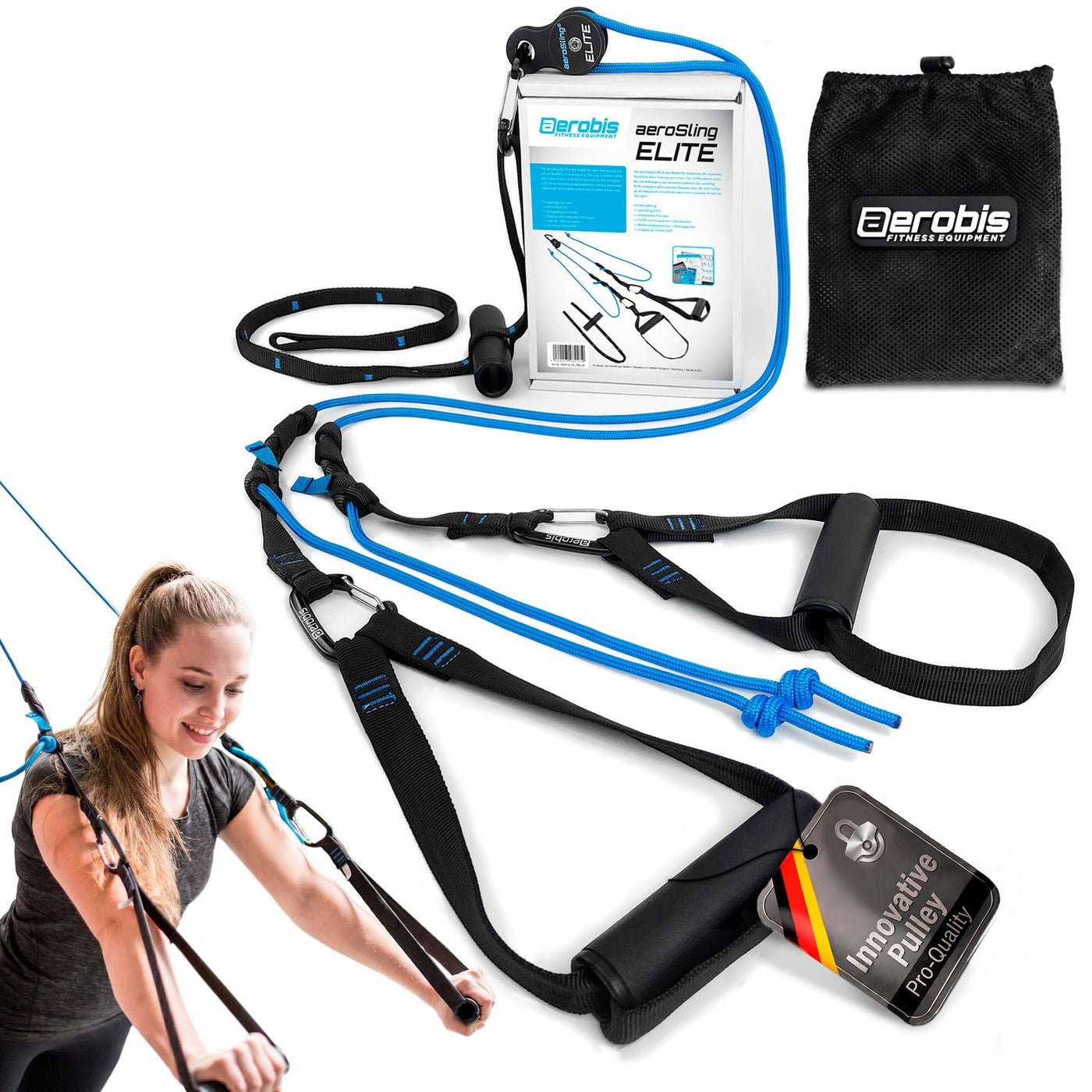
- Bar-loaded pallof press. Clip your bands to a bar like the aerobis Rowstick and press with a wider grip. The longer lever amplifies every rotational force and lets you combine presses with rows and rotational work in one setup.
Variations with a bar increase the lever arm and make the anti-rotation challenge even bigger.
Which band do you need?
Band choice makes or breaks this exercise. Our latex-free Premium Powerbands are made from smooth silicone, each 100 cm long and 4 mm thick, and come in four widths from 10 mm to 40 mm with up to 40 kg of resistance per band:
- Light (10 mm, up to 10 kg): the sweet spot for most people learning the pallof press, and perfect for warm-up sets.
- Medium (20 mm, up to 20 kg): for trained athletes and for shorter iso holds with high tension.
- Heavy and Very Heavy (30 mm and 40 mm): usually too strong for strict pallof presses, but ideal for banded squats, rows and assisted pull-ups - so nothing in the set goes unused.
Because every band stretches up to 300 %, you can fine-tune the resistance simply by standing closer to or further from the anchor. That built-in micro-progression means a single band covers you from your first rep to advanced training. You will find all resistance levels and accessories like anchors, handles and the Rowstick in our Powerbands collection.
How to program the pallof press
The pallof press fits almost anywhere in your training week. Three proven ways to use it:
- As activation before lifting: 2 sets of 10 to 12 reps per side with a light band. Your bracing will feel noticeably sharper in the squats or deadlifts that follow.
- As core strength work: 3 to 4 sets of 8 to 10 slow reps per side with a stronger band or more distance to the anchor, 2 to 3 times per week.
- As a finisher: 3 iso holds of 20 to 30 seconds per side at the end of your session.
Progress by adding a second or two to the pause, stepping further from the anchor, or moving up a band width - in that order. Anti-rotation training rewards patience and precision far more than brute force.
The bottom line
The pallof press is one of the highest-value core exercises you can do: joint-friendly, scalable from rehab to elite sport, and doable anywhere you can anchor a band. Grab a band, find a post, and give your core the job it was actually designed for - keeping you stable while everything around you moves.

Leave a comment
All comments are moderated before being published.
This site is protected by hCaptcha and the hCaptcha Privacy Policy and Terms of Service apply.