

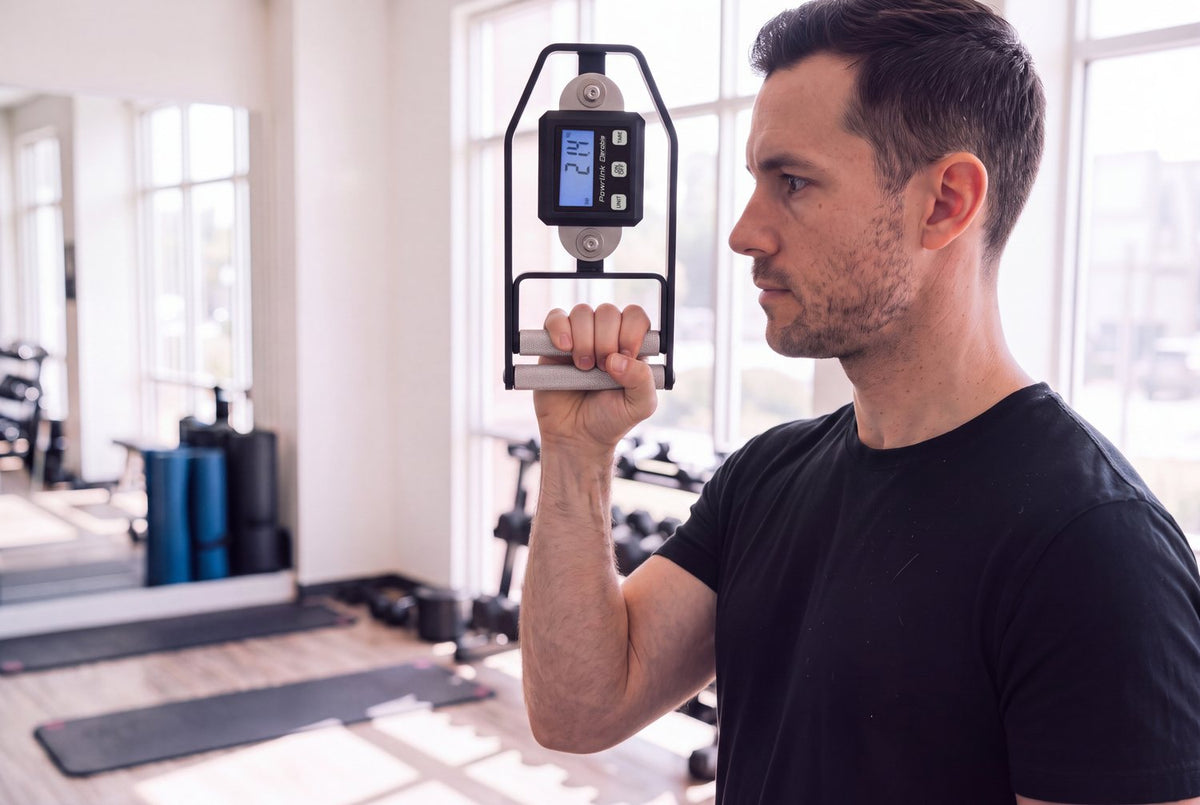
Short answer: There is no single best grip trainer, because each type trains a different part of your grip. For closing strength, a hand gripper in graded levels works best. For beginners and rehab, an adjustable hand gripper or a soft grip ring is the easier start. Add an extensor band so you also train the muscles that open your hand. If you want to know whether your training works, measure it: a digital hand dynamometer such as the Powrlink Grip Strength Set shows your grip strength in kilograms, live and repeatable. For most people, one grip trainer plus regular grip strength measurement is the best setup.
Grip trainers are small, affordable and easy to use at home, at work or when traveling. They differ in what they train, how you set the resistance and whether you can see your progress. This guide compares the main types, shows which one fits your goal and gives you six checks before you buy.
What does a grip trainer train?
Your grip has four parts, and no single tool covers all of them:
- Crush grip: closing your hand against resistance, for example when you squeeze a gripper or shake hands.
- Support grip: holding on for a long time, for example when you carry heavy bags, hang from a bar or hold a Kettlebell.
- Pinch grip: pressing your thumb against your fingers, for example when you lift a book by its edge.
- Extension: opening your hand and spreading your fingers. These muscles balance the finger flexors and are often ignored.
Grip trainer types compared
| Type | Trains | Resistance | Measurable progress | Best for |
|---|---|---|---|---|
| Spring hand gripper (models from other makers) | Crush grip | Fixed per gripper, you buy several levels | Only by the level you can close, ratings differ between makers | Strength athletes and anyone who wants a stronger squeeze |
| Adjustable hand gripper | Crush grip | Set with a dial or slider | Rough, the scale is rarely calibrated | Beginners, rehab, small steps |
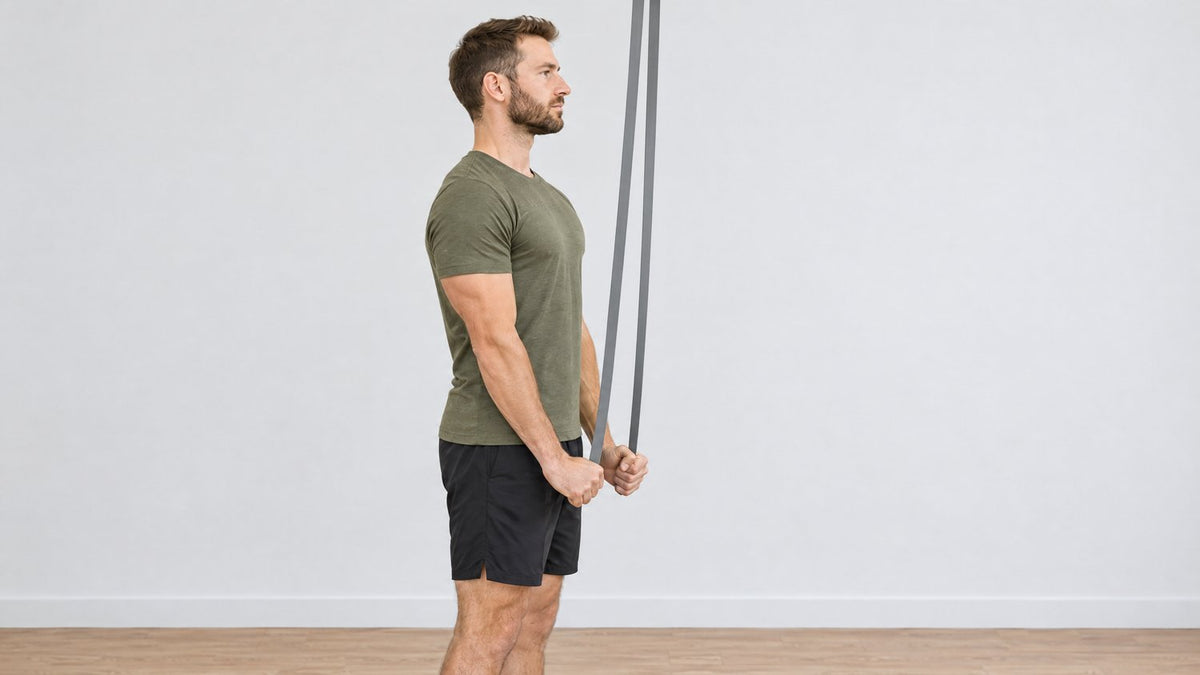
| Finger extensor band | Extension | Fixed per band, often sold in several strengths | No | Balance for climbers, musicians and desk workers |
| Grip ring or grip ball | Crush grip, endurance | Low, fixed per ring | No | Warm-up, rehab, light daily practice |
| Loaded carries and holds, e.g. aerobis Kettlebell or Sandbag | Support grip, forearms, whole body | Fillable, so you choose the weight | By weight and holding time | Full-body training with real carrying strength |
| Digital hand dynamometer, e.g. aerobis Powrlink Grip Strength Set | Maximum squeeze, isometric holds | Your own effort against a fixed frame | Yes, in kg, live in the app | Tracking progress, coaches, physios, climbers |
Which grip trainer fits your goal?
- A stronger squeeze for lifting or combat sports: hand grippers in two or three levels, plus heavy carries with the Kettlebell or the Sandbag for support grip.
- Climbing: finger and support strength come mostly from climbing itself. Add an extensor band for balance and test your maximum grip regularly to see whether your training works.
- Office work, gaming or music: a grip ring or a light adjustable gripper for short breaks, plus an extensor band.
- Coming back after a hand or wrist injury: start light with a ring or an adjustable gripper and follow the plan from your physio or doctor. A hand dynamometer shows how close the injured hand is to the healthy one.
- Staying strong as you age: your grip is part of everyday strength, from carrying bags to opening jars. Measure it a few times a year and keep it up with carries and regular strength training.
How to choose a grip trainer: 6 checks
- Goal first. Decide which part of your grip you want to train, then pick the type. A gripper does little for opening strength, and an extensor band does little for your squeeze.
- Resistance range and steps. Small steps help you progress without overloading your tendons. With fixed grippers the jump between levels is often big, so start one level lower than you think.
- A number you can trust. Every maker rates the strength of its spring grippers differently, and the spring softens over time. If you want reliable numbers, use a device that measures your force directly.
- Build quality. Steel frames and knurled handles last longer and do not slip when your hands sweat. Cheap plastic and soft foam wear out quickly.
- Fit for your hand. If the handles are too far apart for small hands, you lose force and your results get worse. Look for adjustable handle positions.
- Easy to take along. A trainer that lives on your desk or in your gym bag gets used more often.
How to measure grip strength at home with a hand dynamometer
Grip strength is measured with a hand dynamometer. You squeeze a fixed handle as hard as you can for a few seconds, and the device shows your force in kg. Keep the test the same every time: same handle position, elbow bent at about 90 degrees, three attempts per hand, and the best value counts. You can compare your result with typical values in our article on grip strength by age and gender.
The Powrlink Grip Strength Set turns this into a quick routine. The Powrlink sensor sits in a powder-coated steel frame with knurled grips and measures up to 300 kg with an accuracy of up to 100 g. The grips mount in two positions for smaller and larger hands. The free app for iOS and Android shows your force live, saves every test and exports your data as CSV. Without a phone, the Max Power mode on the sensor holds your best value. If you already own a Powrlink or Powrlink Light, you only need the Powrlink Grip Strength Frame.
Do grip trainers actually work?
Yes, as long as the resistance is high enough and you increase it step by step. Your grip muscles adapt like any other muscles. Progress slows down over time, and then you need more resistance or a different kind of grip work. A test every few weeks shows you whether you are still getting stronger.
Grip strength training: how often should you train?
Two to three hard sessions per week are enough for most people, with at least one rest day in between. Light work with a grip ring or an extensor band can be done more often. Tendons adapt more slowly than muscles, so add resistance gradually and stop if you feel pain in your fingers, wrist or elbow.
Common buying mistakes
- Choosing a gripper that is too heavy and never closing it fully.
- Training only the closing movement and never the opening.
- Comparing kg ratings between different makers.
- Going all out every day without rest days.
FAQ
What is a hand dynamometer?
A hand dynamometer measures in kilograms how hard you can squeeze. You squeeze a fixed handle for a few seconds, and the device shows your peak force. Use the same grip position every time so your results stay comparable.
Is a grip strengthener the same as a hand dynamometer?
No. A grip strengthener, also called a grip trainer, is a tool you train with. A hand dynamometer shows how strong your grip is. Most people get the best result from one trainer plus regular measurement.
Is a hand gripper enough for strong forearms?
A gripper mainly trains the muscles that close your fingers. For stronger forearms, combine it with heavy holds and carries, for example with a Kettlebell or a Sandbag, and with pulling exercises.
What is a good grip strength?
That depends on your age, sex and body size. You will find typical values in our article on grip strength by age and gender. The most useful comparison is with your own earlier results.
Can I train my grip every day?
Light practice, yes. Maximum efforts need rest, so keep hard sessions to two or three per week.
Can I also train with a digital hand dynamometer?
Yes, for isometric work. You squeeze up to a target value, for example 70 percent of your maximum, and hold it for a few seconds while the app shows your force live. It does not replace a hand gripper for full closing reps, but it shows you exactly how hard you work.
Your next step
Not sure which grip trainer you need? Start by measuring. Read how to measure your grip strength and compare your result with the norms in our article on grip strength by age and gender.
You will find all details on the product pages of the Powrlink Grip Strength Set and the Powrlink Grip Strength Frame.

Leave a comment
All comments are moderated before being published.
This site is protected by hCaptcha and the hCaptcha Privacy Policy and Terms of Service apply.